Showing posts with label RV-12. Show all posts

Saturday, October 16, 2010

Simplifying the equation

Here's the equation that's been bothering me:

X + Y = ???,

      where X = Will This Airplane Fly and Y = Can I Fly This Airplane?

Granted, it's a year away at least, but it will have to happen eventually. There will inevitably come a day when I have to fly this thing, and it's apparently never to early to start worrying about it. I wouldn't call it butterflies in the stomach at this distant point, but pupae in the belly wouldn't be too far off the mark.

I simplified the equation today. There will still be worries over the fundamental airworthiness of the completed airplane, but at least I will know for a fact that I can fly it. Today I flew a little more than an hour in the left seat of an RV-12 and made a total of three takeoffs and landings. As a bonus, I also made a fourth landing approach and a go-around. For practice, like. Or so I would have you believe.

In what has to me one of the most masterfully created win-win deals of the young century, I offered to assist a sort-of local RV-12 owner with an introduction to the operation of his Garmin 496 GPS in exchange for a little more time riding around and getting familiar with the flying qualities of the -12. He flew up from Lancaster to pick me up at Bolton and while we were chatting on the ramp in front of the tower, he shifted over to the right side and offered me the Captain's position. Yowza!

Before we started the engine, he gave me a quick tour of the Dynon D-180 so I'd know where to look for interesting tidbits of trivia such as our altitude above the ground and our velocity through the cool fall air. Good stuff to know, those things. The increased level of complexity and sophistication over the more pedestrian mechanical equipment in my RV-6 was in stark contrast to the amazing simplicity of engine management. Time to start the engine? Fine, show me the mixture knob. What do you mean, "there isn't one?" How can that be? Okay, fine. Turn the key? Piece of cake. Whoa! I was expecting to click through left mag, right mag, both mags, and then into 'start'. The last thing I expected was to turn the key straight into 'start'. And wow, it sure does start easy, doesn't it?

Taxiing was a little odd too. Rather than the steerable tailwheel I'm used to, there's just a castering wheel out front. Pressing the rudder pedals has no effect whatsoever on steering. No problem, though. I adjusted right quickly to getting turns started with a little jab at the brakes and stopped with a little jab at the other brake. At the end of the runway, I received a briefing on how to perform the takeoff with the least amount of stress on the nose wheel. The idea was to hold the stick back as I fed power in, and not be surprised when the nose lifted almost right away. Once it did, I was to lessen the nose-up stick and let the nose kind of find its own level. The plane would fly away on its own when it was ready. It sounded a little complicated, but in the event it was quite simple. It was a good thing that I had been forewarned that it would feel like I was going to bounce the tail on the runway with the extreme feeling nose up attitude or I would have panicked and plopped the wheel right back down onto the runway.


I fed the throttle in slowly, but even still it was only a matter of a few hundred feet before we were climbing away from the runway. I have no numbers regarding climb performance to share, unfortunately. I sure that data was available on the display somewhere, but as with the rest of the performance data I found it much more difficult to deduce values from a simply glance like I can with my old clock face gauges. I can tell you this: it was slower than in the RV-6. I knew that would be the case going in, though. It was not a surprise.

I was ready for the light aileron forces, having experienced them in my previous ride, but this time around I realized that the -12 is actually lighter in aileron than the -6. It's actually what I would describe as nimble. As we were climbing away from Bolton, I spent a few minutes explaining how to enter a destination into the GPS. With MadCo firmly locked in, I also took the liberty of reconfiguring the GPS screen to what I consider to be a more useful page setup. I like to split the screen between the moving map and the HSI direction indicator. I think it's a more natural way to look at it for old school pilots.

As we approached MadCo, I became increasingly aware of one thing about the RV-12 that I don't like. More specifically, it's something about the Rotax engine. For some reason that I'm sure would make perfect sense to somebody like a trial lawyer, there is a very strong spring on the throttle that is perpetually trying to pull the throttle knob to the full throttle position. That's all well and good for those times when you want to blast around at full bore, but for the rest of the time it's a right bugger. You see, to keep the throttle from working its way forward, you have to lock the friction control on the throttle down as tight as it will go. That makes power changes somewhat of a struggle. Not knowing any better, I loosened the friction and pulled back the throttle for our descent into the landing pattern. Imagine my surprise when I noticed a couple of minutes later that we not only weren't descending, but weren't slowing down either. The throttle had returned to the higher power position of its own volition. I was to be mildly irked by this behavior for the rest of the flight.


We entered a left downwind to runway 27 and were confronted by the challenge of my first landing with a wind that was blowing directly from.... the west. Right down the runway. What could be easier! As I dropped the flaps (accomplished quite quickly in the -12 by virtue of a flap lever rather than the glacially slow electric flaps of my -6) I hardly noticed any nose down movement at all. Lowering the flaps in the -6 has a far more pronounced influence on the trim. In subsequent landings I would notice that there is a pitch trim change required when lowering the flaps in the -12, but it's minimal. What's far more noticeable is how much heavier the ailerons get when the flaps are down. I don't know if that's by design or just a lucky fluke, but it adds a nice feeling of stability in the landing pattern.

I came down final at 65 - 70 knots and entered the flare at 65 knots. I deliberately flew a much shallower glide path than I do in the -6, correctly thinking that the -12 probably wouldn't be able to lose altitude as quick and easily as I can in the -6. I found out later that while it doesn't come down quite as rapidly as the -6, it is still pretty capable of coming down when you need it to. As I flared over the runway, I was pleasantly surprised at how much more feel I had than in the -6. With the -12, I could move the stick quite a bit in pitch with minimal yet predictable changes in the landing attitude of the plane. The -6 is, in comparison, very twitchy in the flare. The least little movement has a tremendous affect on the attitude of the plane, and in consequence can cause all kinds of embarrassing bounces and oscillations. At the end of the day, it came down to this: I greased all three of my landings, at least on the Richter scale that I use for grading landings in the -6.

I mentioned a go-around earlier. After MadCo we headed over to Circleville to try a crosswind landing. Without the wind coming right down the runway to abate our ground speed, I ended up high and fast on short final. I punched in a bootful of right rudder and held the wings level with left aileron and we dropped down like a brick, but I still felt that an awful lot of runway was sliding behind us and the plane wasn't perceptibly slowing. Discretion being the better part of valor (and me not wanting to abuse the generosity of my host), I poured on the coal and took us around for another try. Better attuned to the weather conditions and the performance of the plane, I squeaked on the second attempt. Two for two, if you don't count the go-around. Call that one a mulligan.

By the time we got back to Bolton, I was completely comfortable in the airplane. While it will take time to adjust to a 110 knot cruise speed, I will quickly learn to love the 5 gallon per hour fuel flow. The benign flight qualities will please, but the bouncing around that comes with the light wing loading will take some adjustment. I was again surprised at how quiet and smooth the engine is and how comfortable the seats are. And the improvement over the already exemplary visibility of the RV-6 is amazing.
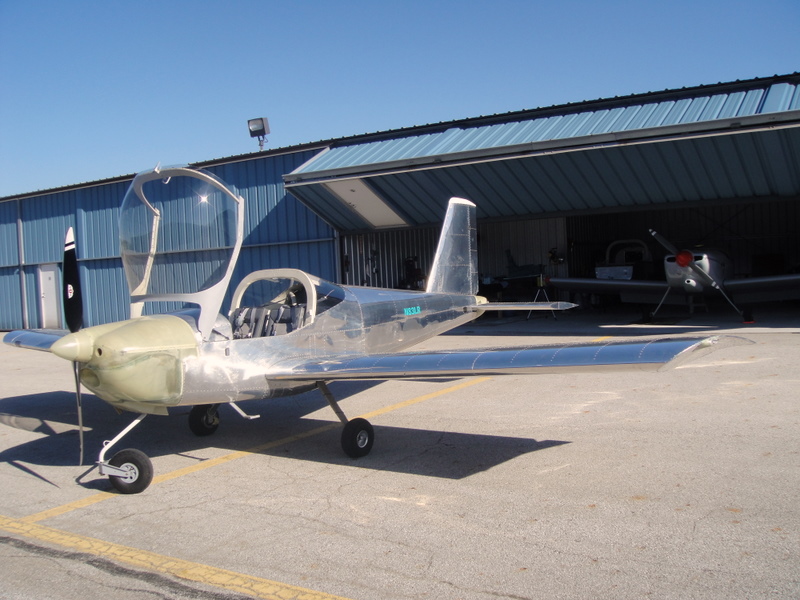

All in all, I can say in all honesty that the RV grin that I wore for the rest of the afternoon was well earned by that wonderful little airplane.

Saturday, June 12, 2010

.25 in a 12

It probably seems odd that I would jump into building an RV-12 without ever having so much as sat in one, but it's not as uncommon as you might think. It happens all the time, starting with Orville and Wilbur, if you think about it. That doesn't mean it's a comfortable thing, mind you. You might think that the worst case scenario is that I spend years building the plane and then find out that I don't particularly like the way it flies, but if you think about it for a second you will realize that there's an even worse thing that could happen: my first flight in the airplane would also be my first flight in that kind of airplane. Learning on the fly, so to speak. So not only would I be wondering if the plane would actually fly, I'd also be worried about whether the pilot could actually pilot it.

That issue was partially resolved today. I've been helping a fellow RV-12 builder with the configuration chores for all of the electronic gadgetry in his plane. Today I hoofed it over to Lancaster (KLHQ) to set up the part of the Dynon display that indicates the trim position. I drove over rather than taking the RV since the weather forecast was typical Ohio weekend: thunderstorms with the chance of more thunderstorms. Better to drive, I figured. That said, the weather had not yet finished its slide into the forecast crud, so there was a small window of opportunity for my first ride in an RV-12. The fuel tank was going to need to be removed later in the day, so burning off a gallon or two was deemed preferable to draining it out. To be honest, I didn't need much arm twisting to talk me into it.

While Mr. Rush was preflighting, I was busy taking pictures of areas of interest. "Areas of interest" to a builder is defined as the parts of the airplane currently under construction. In my case, that is the bottom chunk of the fuselage, in specificity the steps used to climb up onto the wing to enable ingress into the cockpit.


You can, of course, read all about that over on the Schmetterling blog.

The RV-12 is a few inches wider than the RV-6, so the seating was quite comfortable. The Rotax was a little reluctant to start but finally got its wind up with the application of the choke knob. New stuff already - my Lycoming doesn't have a choke knob. Once the engine was running (very, very smoothly!) the avionics master is turned on and the light show begins.


As we taxied out for takeoff, I made some adjustments to the avionics. Having just gone through this with my Garmin 396 last year, I was able to find the menu page on the 496 to shut off the highly irritating XM radio commercial that plays through the headsets. I also found the page to increase the brightness on the 496's screen - it was set low enough to be nearly invisible.

At the end of the runway, I saw one of the really cool differences between the old mechanical gauges of my RV-6 and the modern computerized stuff in the 12. Consider this picture:


The oil temperature is at 100 degrees, still twenty degrees below the 120 required by Rotax for exceeding 2,300 RPM on the engine. The engine RPM is shown in the upper right corner of the display - it was 2,240 RPM at the time. Notice that the RPM needle is in a very small green arc region, with yellow and red at higher RPMs. Now look at this picture:


The oil has warmed to 128 degrees and the colored arc around the tach has changed accordingly. The green arc has expanded to the full operating range of the engine. Let's see a mechanical tach do that!

The takeoff was brisk, quite possibly even more sprightly than the -6. We climbed out at 80 knots, showing about 800 feet per minute climb on the Dynon (once I was showed where to look for it, that is). The view over the nose was something that I expected to be better than the taildragger RV-6 on the ground, but I was still impressed with the forward visibility in the climb, too.


I took over the flying once we got away from inconveniently close objects and any other obstructions that I might fly into. I found the handling of the RV-12 to be very similar to the RV-6. It is nicely balanced in pitch and roll, meaning (to me, anyway) not that the forces in each axis are identical but rather that they go together as well as macaroni & cheese. The roll forces are light and the wing is willing and responsive, much like in the -6. This is often confused with "twitchy," but that's not an apt description. It's more accurately described as "turning by thought." You think about turning, your hand makes a small gesture of agreement, and the plane turns. This is wonderful in the roll axis (for VFR flying, and with an autopilot available to lend a hand while you nap or use the potty bag) but not at all desirable in pitch. When it comes to pitch, I want the plane to be a little more reluctant about changes. I don't want it to feel stiff, but I do want it to feel stable. That's the way the -6 is, and to my immense pleasure, that's the way the -12 is.

The RV-6, as with most (if not all) of the RVs, is tremendously easy to see out of. The -12 is even better. The aft location of the wing clears a lot of view downward. It's going to be fantastic for a photography platform.

I removed my headset for a few moments to see how loud the Rotax is. I've heard it described as quite noisy, and I suppose it is if you're used to heavier, store bought planes. I didn't think it was any louder than the RV-6. That's not to say that it isn't loud; it is. It's just that I'm used to it.

This being an Ohio weekend, the current weather had exceeded its five minute sell by date and was starting to look a little nasty. The few gallons that needed burned off were gone, so it was back to the airport.


Trust me, I have an RV grin on the inside!


Back in the pattern, the plane slowed down nicely. Since we were close to very hard and immovable things again, Mr. Rush was back on the stick. I begged a few seconds to see what the controls felt like at the slower speeds in the pattern and found that the forces hadn't changed much. That's a good thing, I figure. It didn't feel mushy. Mushy controls at landing speeds are what convince pilots that they are going too slow. This is how airplanes like Mooneys end up getting a bad reputation for landing "hot" and being "floaters."

I didn't make the landing, but it looked easy enough. For all I know, Mr. Rush's 3,300 hours have resulted in a "greaser every time" capability, but what I know for sure is that the landing he made for me in the -12 was a real keeper. Hopefully that had more to do with the airplane than it did with some form of super human ability and I too can finally make landings that don't have their own designated Seismic scale once I get my RV-12 done. 

Having had the dance, it was time to pay the piper and get busy on the Dynon work. As I get more comfortable with the menus and navigation on the Dynon, the easier it gets. It didn't take long at all to get the trim indicator working. Once you learn your way around the menus, it gets quite easy. You find the thing you want to configure and the Dynon provides step by step instructions. Very cool!

I'm glad we did the flying early; it wasn't long at all before the weekend weather arrived. These guys waited too long.

Sunday, November 01, 2009

Schmetterling CEO Visit

As a major milestone approaches with the imminent completion of a major aerodynamic surface and flight control, it seemed that it might be a good time for the CEO of our parent company to come for a visit to the production facility. VIP treatment is standard for situations such as these so I took the company plane out to pick him up.

Or, put another way, the weather was gorgeous today and was almost irresistibly beckoning me, but the RV-12 rudder is on the cusp of completion and I really wanted to spend some time doing that. But... there's just no denying the call of a sky that appears as if it may have once or twice heard whispered rumors of these new fangled things called 'clouds' but was believing none of that wild gossip, thank you very much. And calm winds in the forecast as well! Astounding! What better way to kill two birds with one stone (hmm, this seems like a wildly inappropriate time to use that expression) than to fly out to KVES and pick up my Dad and fly him back to Columbus for a shop visit. Sure, it would mean flying him back as well, but seriously, isn't that just a cherry on the sundae?

It was a relaxed morning what with the DST 'found' hour to buffer the time between having a hot cup or two of Vitamin P infused coffee and having to head to the airport for departure. There's no lav in an RV-6, remember? Timing is critical.

The extra hour came from Daylight Savings Time ending later in the year than ever before because our Congress, always eager to flaunt their dominance over us, legislated a seemingly random change in when we shift time. They meddle in so many things anymore that I think a House bill to coerce water into flowing up hill is expected to get voted out of committee next week.

In any event, no one bothered to tell my Garmin 396 of the change of schedule. Try as it might, it just could not find any satellites, my theory being that it was looking at points in space that wouldn't be inhabited by GPS satellites for another hour. Or spots from which satellites had already departed an hour earlier. It could be either - I'm not very good at temporal calculations. If I had to bet, I'd say it was the latter case.

Whatever the cause, buggered if I was going to sit around waiting three months for the clocks to get set back ahead. I'd go without it - I have a nice spare built right into the panel. Although I rarely use it, I do dial in Direct To now and then just to remind myself how. That came in handy today since it was super simple to just dial in KVES and get things going. It's a little less pleasant than the Garmin to use, though:


Always the forgive and forget type, I gave the Garmin another chance. And another, and another, and another. I diddled around with menu pages trying to find a place where I could set the time and, for that matter, the date. It was convinced that it was October 28th. Brilliant little box, but sometimes easily confused. I couldn't find anything that would let me give the unit a temporal foothold on reality, but I did find a way to turn off Daylight Savings Time. I was optimistic about that, but the Garmin stubbornly continued to play the fool:


Finally I stumbled upon a 'Set Location' menu item. Just what I was looking for! You just pick a spot on the map or type in an airport identifier and Bob's your uncle. Well, not so fast: it seems that rather than give it a location as you're pounding through the air at a blistering 3,139 inches per second, you have to be sitting still. I typed in a couple of airports as I flew over or by them, but no luck. As soon as I stopped at KVES, POW!, it found all the satellites it could ever want.

That solved, I got the CEO settled into the right seat and we were off on the trip back to Columbus. The whole VIP thing kind of went sour, though, since I had forgotten to bring the passenger headset. He had to endure the full, unadulterated cacophony of Papa at full gallop. At first I tried cruising at a sedate 2,000 rpm to keep the noise down, but I quickly got bored with that and poured on the coal. After a fuel stop at MadCo, we landed at Bolton and hangared Papa. It was time to visit the shop.

I had the rudder pretty much ready to go for final assembly. Just to provide a complete picture of the work involved, I hadn't deburred the rudder skin yet. A few passes along the Scothbrite wheel made short work of dressing up the edges of the skin and the deburring of the rivet holes is never all that time consuming. It wasn't long at all before we were ready to take the rudder back to the hangar for riveting.

With the construction of the tail kit being well ahead of schedule and the lead time for the next kit (the fuselage) now hovering at somewhere around two months, and in consideration of the all too likely end of year price increase, the discussion turned to whether the order for the fuse kit should be placed. The timing of the tail is looking like I will be ready to assemble the too-big-for-the-shop tail cone by the end of December, just in time for the most inhospitable months of the year for working in the hangar. With the fuse kit on site, I could defer the building of the tail cone until Spring and concentrate on the first stages of the fuselage. Right up until the roll bars go on, the fuse is small enough to assemble in the shop.

As with CEOs everywhere in Corporate America, they need time to think about schedule changes. Deep in thought:


My only fear is that the vertical stab and rudder might be lulling me into over confidence. Maybe the horizontal stab is when this stuff really starts getting hard. I have to say, though, that the RV-12 so far has to be the simplest to build airplane in the world. Seriously, look at this:


The fronts of the rudder skin were already rounded into shape and fit right together with no trouble at all. The skin slid right onto the skeleton and the holes lined up with unconscionable ease. I don't think you can build an RV-9 rudder in just a handful of hours, can you? This thing is amazingly well designed.

We hauled the rudder out to the hangar and pulled about 3/4s of the rivets before we started getting pretty hungry. Also, with the loss of an hour of daylight I had to keep a tight look on the time to make sure I could be back to base before dark. We decided that we'd get started back towards KVES with a lunch stop at Urbana. I always seem to end up at Urbana...

Hey, you know how you always want to impress your Dad? Well, I got a little help with that today from a couple of total strangers.

"See the kind of people that have planes at Bolton? The kind that drive Porsche and Rolls Royce:"


"I just drive a Subaru because I find spectacularly conspicuous consumption like that somehow demeaning." Yeah, that's the ticket.

After lunch, I had him stand next to his artwork for a picture:


The flight from Urbana to KVES went fine, although I wouldn't say it was the best landing of the day. The best was a greaser at Urbana. The rest were so-so. The winds were a bit shifty and three out of the six landings were made with light quartering tailwinds. I'm not saying that's what caused the bad ones, but it could be.

The Sun was getting pretty close to the horizon as I flew back towards home, providing perfect lighting to capture a late Fall tapestry:


Bolton tower had been using runway 4 for most of the day but as I was approaching I heard the tower clear a couple of departures to go out on 22 since they were heading southwest. That meant that I had to land on 22 also, and that meant another landing with a slight tailwind. And, it sucked. I sailed right on past taxiway Alpha 3 and couldn't make the turn off until Alpha 4. That's not a big deal as there was another half a mile of runway after Alpha 4, but it's still a bit below my standard. Eh, it happens.

Once back I finished up the remaining riveting and headed home with a completed rudder:


Next comes the anti-servo tab. I'll 'splain just exactly what that is next time.

Sunday, October 25, 2009

Fall Colors

The forecast for this morning called for classic brisk fall weather, cool but clear. With that in mind, Co-pilot Rick and I planned for a trip down to Portsmouth for breakfast, hoping to grab some pictures of the stunning Fall colors we're seeing this year. Unfortunately, the clear morning was running late - we had a light fog at Bolton and Portsmouth was reporting 1/4 mile visibility and 100 foot ceilings. Uh, no. That won't do at all! We postponed our departure and I took the newly found time down to the Schmetterling Aircraft production floor to spend some quality time on the RV-12 tail.

Things at Bolton had cleared up by the newly established departure time of 10:30, but Portsmouth was still reporting horrible conditions. It's an odd airport, though. They will sometimes be reporting conditions that would ground even the bravest horsefly on one end of the runway while the other end is sparkling clear. Worth a look, we figured. With the fallback plan of simply turning around and heading back, we launched ourselves to the south.

It was indeed a pretty Fall day:


At first, anyway. As we approached Portsmouth, it became apparent that we would be eating elsewhere. Still, it was pretty:


Somewhere down under that blanket of clouds lies Portsmouth.

We turned tail and fled back to the clear air of Columbus.

It was a nice day to fly, though, even without accomplishing the breakfast mission. And that left plenty of time in the day to get back to work on the RV-12. I got quite a bit done on that:


Monday, September 28, 2009

Rainy weekend...

Housebound for most of the weekend, although the rains did abate for just long enough to mow the lawn. While I was out there putzing about in the yard, I also decided to unclog one of the rain getters that I had seen overflowing during the downpour:

"I'll take 'Things That Shouldn't Have Been a Surprise' for $500, Alex."

"And the answer is, 'You get drenched with cold water.'"

"Ooh, I know that one! 'What happens when you stand under an overflowing rain gutter and remove the clogged down pipe?'"

Ding ding ding! $500!

Later in the day, it was a trip to the mall with Co-pilot Egg for to procure a spiffy dress for the Homecoming dance. At Macy's. On a Sunday afternoon. I thought it was bad enough when I was surrounded by a pack of ravening, giggling teenage girls, but no, the worst of the pain was yet to come. It was the 20 minutes that she was in the fitting room trying on dresses that really made me uncomfortable. Because, well, Macy's thought for some reason that the optimal area to put the fitting rooms was deep in the heart of the 'intimate apparel' department. I retreated as far as I could without running the risk of losing the co-pilot, but that was only a slight improvement: night gowns and robes.

Salvaging as much of my masculinity as possible after that ordeal, we stopped at Lowe's and bought pieces/parts required to build a work table for the RV-12 project. That marks the official beginning of the build process, in my opinion. But you'll have to read about it at the Schmetterling Aviation blog.

Tuesday, September 22, 2009

New RV-12 Site

It makes sense to have a separate site for RV-12 related topics. There is a new image at the top of the right side bar showing the logo for the fictional Schmetterling Aviation. Click the logo to go to the new site.

The Papa Golf Chronicles is not going away; I still have an RV-6 to fly!

Monday, September 14, 2009

On building an RV-12

If nothing else, I think I will build the tail over this winter. I'm not a very outdoorsy type in the bitter cold weather anymore and I need a project to keep myself occupied. The beauty of the RV-12 tail kit is that the vast majority of the work can be done in my basement. Because it includes the tail cone, the final assembly of the tail would have to be performed somewhere above ground. I'm not keen on leaving the cars out on the driveway so using the garage is out of the question, but I have plenty of room in the hangar to do the final riveting.

The advantages of starting with the tail are related to cost. The kit is $2,150 plus shipping which is a very small initial expense when compared to the overall cost of the kit. Another benefit is that there is resale value for the tail should I decide that I don't want to proceed with the rest of the build. There will be a very large number of RV-12s built, so there will therefore be a ready market for a completed tail. Why not buy one already done for the same cost as the kit itself?

The more important and difficult decision will be whether or not to continue to build the rest of the airplane. As the build process progresses, both the cost and the physical size of the components increases dramatically. I would be reluctant to build an entire wing or fuselage in the hangar, but if there is a reasonable ratio between time spent fabricating or preparing individual parts before assembling them into or onto a prohibitively large structure, well, that would be different. If I could take a bunch of deburred and fluted ribs out to the hangar to final rivet onto the spar, for example, the time spent in the hangar would be minimized. That's only really important for the three or four months of bitter winter cold; a good fan would keep the hangar at a suitable temperature for all but the worst of the summer days.

Along that line of thought, I asked Wingman Ted, who is currently building an RV-10, what that ratio might be. His estimate is 50-50. So, half the time would be spent preparing parts in my basement, the other half would be spend assembling them in the hangar. This would inevitably slow the pace of the project somewhat, but I think it's important to note that I have an advantage over the more typical builder: I already have an airplane to fly. What do I care if it takes five to seven years to finish an RV-12? And with the option to bail out and sell the partially complete kit any time I want, I don't see much financial risk to the endeavor.

So, why an RV-12 in the first place? Well, I ain't getting any younger and the LSA airplane has the benefit of removing any worries over losing my medical. That is, after all, how I got my RV-6. I think the guy that built it only put 155 hours on it before losing his medical. And, although the RV-12 is 30 knots slower than the RV-6, it is more capable when the winds get higher than my comfort level in the taildragging, small rudder RV-6. And with a nosewheel, the RV-12 would be suitable for flight instruction. That would be a boon to co-pilot Egg!