It was a long 10 weeks, but a very valuable class. The experience of removing an O-320 from a Piper and completely disassembling it, putting it all back together, hanging it back on the airplane and actually seeing it run was fascinating and rewarding. I've always treated the engine as some kind of mysterious, sacrosanct, magical lump of aluminum and steel, and having seen the inner workings has reduced some of the awe-factor and replaced it with a more useful and appopriate understanding of how it works, and even more importantly, how to maintain it.
For example, I'm more sure than ever that I need to get an Exhaust Gas Temperature (EGT) gauge in my panel. For those that are unaware, an aircraft engine does not set its fuel/air mixture automatically the way a car engine does. As the aircraft climbs into the thinner (less dense) air, the fuel/air mixture has to be manually leaned to keep it from running with too rich of a mixture. Running too lean, though, can cause serious and expensive damage to the (very expensive!!) engine.
The proper way to do this leaning is to ease out the mixture knob while monitoring the temperature of the exhaust gases coming from each cyliner. As the mixture becomes leaner, the temperature of the gases will increase. If the mixture is leaned too far, the temperature of the exhaust gases will begin decreasing. The point where the first cylinder 'peaks' is a critical point to know, since you will lean no further than that point and will, in fact, richen it back up just a smidgen.
The cylinders will not all peak at the same point due to the somewhat imprecise fuel/air metering provided by a carburated engine. Because of this, it really isn't sufficient to have a single EGT probe, but it's a heck of a lot cheaper to do so. In theory, you could do some form of ground test to try to determine which cylinder peaks first and put the single probe on the exhaust coming from that engine, but I think it is better to have a reading for all four cylinders.
Engine monitoring is an area where you can spend a lot of money. Even a basic electronic four cylinder EGT/CHT (CHT is Cylinder Head Temperature) costs almost $2,000. There are, of course, other parameters that can be measured, and it takes very little effort to run the price of engine monitoring to $3000+. I think I just need the EGT capability, though. CHT doesn't really tell me that much, but EGT is something that can and should be used on every flight. The only question is whether to just monitor one cylinder, or go ahead and get a piece of kit that can do all four. It's really just a question of spending $100-ish, or $400-ish.

Friday, March 14, 2008

Wednesday, March 12, 2008
Another new word: Sitow
It means "Self-Inflicted Tale of Woe."
I've shared many of those on these very pages; so many, in fact, that I was forced to invent the new word.
What was the last straw? Well, it happened just five minutes ago, here at work.
I've been living with, and being egregiously annoyed by, this whistling/squeaking noise up in my office ceiling for weeks/months now, but I didn't want to have building maintenance look for it because I've taped over the ceiling air vents. The vents are situated such that they blow ice cold air down the back of my shirt and generally make me cold. I share a vent with the office next door, and the occupant there is always hot. I figured it was easier for me to solve my problem by wearing heavy clothing and covering the vents than it would be for her to find a workaround for being too hot, so the tape seemed to be the most expedient solution. I used clear packing tape so that my DIY modification would escape casual scrutiny by the building managers.
When the squeaking started, I thought maybe the taped vents had caused some blower motor up there to work too hard and wear out, and the resulting squeal was simply its way of protesting. I finally reached my limit today, though, and got to thinking that I ought to have someone come fix it. Prior to doing that, I thought I ought to get up there and remove the evidence, as it were.
That's when it struck me that maybe the whistling sound was actually being caused by the air blowing through the tape that I had placed over the vents.
It was.
I've shared many of those on these very pages; so many, in fact, that I was forced to invent the new word.
What was the last straw? Well, it happened just five minutes ago, here at work.
I've been living with, and being egregiously annoyed by, this whistling/squeaking noise up in my office ceiling for weeks/months now, but I didn't want to have building maintenance look for it because I've taped over the ceiling air vents. The vents are situated such that they blow ice cold air down the back of my shirt and generally make me cold. I share a vent with the office next door, and the occupant there is always hot. I figured it was easier for me to solve my problem by wearing heavy clothing and covering the vents than it would be for her to find a workaround for being too hot, so the tape seemed to be the most expedient solution. I used clear packing tape so that my DIY modification would escape casual scrutiny by the building managers.
When the squeaking started, I thought maybe the taped vents had caused some blower motor up there to work too hard and wear out, and the resulting squeal was simply its way of protesting. I finally reached my limit today, though, and got to thinking that I ought to have someone come fix it. Prior to doing that, I thought I ought to get up there and remove the evidence, as it were.
That's when it struck me that maybe the whistling sound was actually being caused by the air blowing through the tape that I had placed over the vents.
It was.
Sunday, March 09, 2008
The difference between cats and dogs
Cats:
It's all about the comfort, and if you want any lovin', you'd better bring treats. Cats seem to enjoy puns, too, as evidenced by the silly names applied to said treats.

Dogs:
"You had me at 'outside'":

Full disclosure:
Hogarth's outdoor sojourn was immediately followed by a nap in front of the fireplace, but ever mindful of his reputation as an outdoorsy, rugged sort of fellow and extremely distrustful of the in-house paparazzi and their wild rumor-mongering, he refused to have his picture taken.
He still doesn't fully grasp the concept of a see-through fireplace, though:

The cat? He doesn't care what you think:

It's all about the comfort, and if you want any lovin', you'd better bring treats. Cats seem to enjoy puns, too, as evidenced by the silly names applied to said treats.

Dogs:
"You had me at 'outside'":

Full disclosure:
Hogarth's outdoor sojourn was immediately followed by a nap in front of the fireplace, but ever mindful of his reputation as an outdoorsy, rugged sort of fellow and extremely distrustful of the in-house paparazzi and their wild rumor-mongering, he refused to have his picture taken.
He still doesn't fully grasp the concept of a see-through fireplace, though:

The cat? He doesn't care what you think:

Saturday, March 08, 2008
A life lesson from Brave Sir Hogarth
A lesson on the topic of knowing when to quit, that is.
I let Brave Sir out to play in the snow this afternoon, but after two brief laps around the back yard, he headed for the back door in the hopes of being admitted and heading back to his spot by the fire place. It's not that he doesn't hear the Call of the Wild anymore, it's just that he has caller ID and doesn't always pick up when the wild calls.
As I was out plowing the driveway for the fourth time (!!!) today, I reached the realization that I was pushing around snow that I had no place to put, using gasoline that I did not have. (Yes, I failed to plan ahead well enough to fill the tank on the tractor, but to the positive, I did manage a preparatory trip to the local grocer to stock up on victuals) I parked the tractor and decided that the driveway was as good as I could get it, and if we get anymore snow we will have to use the Power of the Subaru to get through it. As if by divine intervention, the Sun emerged at long last:


I let Brave Sir out to play in the snow this afternoon, but after two brief laps around the back yard, he headed for the back door in the hopes of being admitted and heading back to his spot by the fire place. It's not that he doesn't hear the Call of the Wild anymore, it's just that he has caller ID and doesn't always pick up when the wild calls.
As I was out plowing the driveway for the fourth time (!!!) today, I reached the realization that I was pushing around snow that I had no place to put, using gasoline that I did not have. (Yes, I failed to plan ahead well enough to fill the tank on the tractor, but to the positive, I did manage a preparatory trip to the local grocer to stock up on victuals) I parked the tractor and decided that the driveway was as good as I could get it, and if we get anymore snow we will have to use the Power of the Subaru to get through it. As if by divine intervention, the Sun emerged at long last:


Ah, that lion...
March, in like a lion... I was scoffing at that just a few, short days ago. When will I learn? When will I learn not to ignore decades of conventional wisdom packaged into handy bite-sized nuggets for my convenience? In like a lion, indeed:
Weather-out-the-window(tm):

It's so bad, even the local bath house is closed:


Windy, too. 35 gusting something huge, and as it would be on just about any day, the wind is my enemy. The snow is not yet done falling, but what with my snow removal equipment limited to clearing accumulations of a mere 3 to 4 inches at a time, I have to keep up with it mid-blizzard. We've already had more than that, which in itself would be an increased difficulty, but to add a layer or two of even more increased difficulty the wind has blown it into much higher drifts.
And here, as you've come to expect from this writer, is my self-inflicted tale of woe: in years past, I have put out orange sticks along the edges of the driveway to outline the boundaries of the area I need to plow. The last couple of winters have been relatively light on snow, so the effort of putting out the markers went unrewarded. I didn't even think about it this year. Yesterday, when the first few inches had fallen and the doom-and-gloom weather guessers were calling for another 10 to 12 inches, I decided to go out and plow while I could still see the tips of grass poking out through the ground cover. Thus would be created some mounds of removed snow outlining the areas to be plowed. In theory.
What actually happened is those little mounds acted as accumulators for the snow being driven by the 35 mph winds. In other words, much of the 5 inches of snow laying on the open areas was blown into a nice trough between the mounds, creating a very deep pile of snow, in exactly the worst possible place.
So, on with the nice, warm Walmartt's (tm) that I bought in lieu of the very pricey Carhartt coveralls and out to the mighty 25 hp tractor and attached 48" snow blade. Only to get about 4 feet outside the garage before getting stuck behind the wall of snow that I was pushing. That was pretty much what went on for the ensuing hour (or more, I lost track of the time) of pushing, prodding, coercing, and downright begging of the snow to succumb to my will and get the hell off of my driveway. Going down the driveway was miserable. Turning around and coming back up, right into a 35 gusting infinity wind, itself propelling tiny little grains of sand-like ice directly onto the surfaces of my eyeballs, was miserable times ten.
But finally, FINALLY, enough of the driveway was cleared to get a car down to the impassable, unplowed road. Warm beer, that. A tediously created road to nowhere. It was like digging the Panama Canal, only to find that the Pacific side was only 2 feet deep, and thus useless to the ships that had traversed the canal.
Still, good work has its own inherent satisfactions, right? I backed the tractor into the garage, and as I let it idle for the 30 seconds required to keep it from backfiring when I shut it down, I walked out to survey my success. Which, as you can imagine, was already being filled in by the blowing snow.
Could be worse, though. Brave Sir Hogarth's "relief area" has snow drifts so high that the poor fellow is actually injecting liquid byproducts into the snow.
Weather-out-the-window(tm):

It's so bad, even the local bath house is closed:


Windy, too. 35 gusting something huge, and as it would be on just about any day, the wind is my enemy. The snow is not yet done falling, but what with my snow removal equipment limited to clearing accumulations of a mere 3 to 4 inches at a time, I have to keep up with it mid-blizzard. We've already had more than that, which in itself would be an increased difficulty, but to add a layer or two of even more increased difficulty the wind has blown it into much higher drifts.
And here, as you've come to expect from this writer, is my self-inflicted tale of woe: in years past, I have put out orange sticks along the edges of the driveway to outline the boundaries of the area I need to plow. The last couple of winters have been relatively light on snow, so the effort of putting out the markers went unrewarded. I didn't even think about it this year. Yesterday, when the first few inches had fallen and the doom-and-gloom weather guessers were calling for another 10 to 12 inches, I decided to go out and plow while I could still see the tips of grass poking out through the ground cover. Thus would be created some mounds of removed snow outlining the areas to be plowed. In theory.
What actually happened is those little mounds acted as accumulators for the snow being driven by the 35 mph winds. In other words, much of the 5 inches of snow laying on the open areas was blown into a nice trough between the mounds, creating a very deep pile of snow, in exactly the worst possible place.
So, on with the nice, warm Walmartt's (tm) that I bought in lieu of the very pricey Carhartt coveralls and out to the mighty 25 hp tractor and attached 48" snow blade. Only to get about 4 feet outside the garage before getting stuck behind the wall of snow that I was pushing. That was pretty much what went on for the ensuing hour (or more, I lost track of the time) of pushing, prodding, coercing, and downright begging of the snow to succumb to my will and get the hell off of my driveway. Going down the driveway was miserable. Turning around and coming back up, right into a 35 gusting infinity wind, itself propelling tiny little grains of sand-like ice directly onto the surfaces of my eyeballs, was miserable times ten.
But finally, FINALLY, enough of the driveway was cleared to get a car down to the impassable, unplowed road. Warm beer, that. A tediously created road to nowhere. It was like digging the Panama Canal, only to find that the Pacific side was only 2 feet deep, and thus useless to the ships that had traversed the canal.
Still, good work has its own inherent satisfactions, right? I backed the tractor into the garage, and as I let it idle for the 30 seconds required to keep it from backfiring when I shut it down, I walked out to survey my success. Which, as you can imagine, was already being filled in by the blowing snow.
Could be worse, though. Brave Sir Hogarth's "relief area" has snow drifts so high that the poor fellow is actually injecting liquid byproducts into the snow.
Sunday, March 02, 2008
A not so great day in the Boat Works
My temp worker made an appearance in the shop toady which is always welcome, but the results of our labor are not promising.
Being of the teenage girl persuasion, I was only able to procure slightly more than half of her attention, while the remainder was utilized in important telephonic discussions surrounding the topic of "boys":

We were drilling the match holes that we would use to attach the first of the top side panels. The join did not go well, as you can see from the following series of pictures:


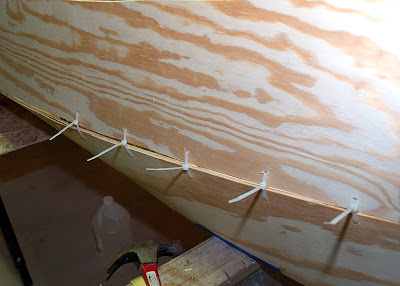

Those gaps are pretty extreme, and I have no idea what I'm going to do about them. I beat a quick retreat from the problem, hoping that some idea regarding how to get a better fit between those panels will miraculously pop into my head. I don't think tie down straps are going to work this time.
Being of the teenage girl persuasion, I was only able to procure slightly more than half of her attention, while the remainder was utilized in important telephonic discussions surrounding the topic of "boys":

We were drilling the match holes that we would use to attach the first of the top side panels. The join did not go well, as you can see from the following series of pictures:


Those gaps are pretty extreme, and I have no idea what I'm going to do about them. I beat a quick retreat from the problem, hoping that some idea regarding how to get a better fit between those panels will miraculously pop into my head. I don't think tie down straps are going to work this time.
Saturday, March 01, 2008
In like a lion...
March: In like a lion, out like a lamb. Or so they say. Weather-out-the-window didn't persuade either way: sunny, with some of those soft, fuzzy clouds that usually spell C-O-L-D floating around at around 3500', and trees swaying in a fairly stiff breeze, but just shy of qualifying as wind. Worth a look, thought I, but moot if I can't surmount the hangar ice wall that has kept Papa captive lo these many weeks.
Nothing for it but to reconnoiter, of course. I drove over at about 0830, and before I even got as far as the hangar I found a problem: those puddles from melted snow... weren't puddles at all. Black ice. Alaska tea. Slippery water, that is. Jeb, move away from there. Figuring that would be nothing but a delay, and not a bad one at that considering that I owed my engine at least a few hours worth of pre-heated oil, I pressed on to the hangar. The ice wall, while certainly not completely gone, had been reduced to a minor annoyance, almost Huckabee-like, if you will.

I plugged in the pre-heater, noted that the ambient light conditions in the hangar were, well, non-existent due to the burned out (presumably) hangar light, and headed back home to wait out the warming of both the pavement and the engine oil.
Figuring that by 1100 or so what's left of Al Gore's tattered Global Warming Crisis had had enough time to work its magic, I returned to the airport. At this point I was still not sure there would be any flying, mind you, as there were any number of concerns left. After all, the battery had been sitting fallow for more than a month through frigid weather and it was by no means a certainty that it would have enough life left to crank the engine. The trusty pilot had weathered this period as well, so there was also the question of aviation competence yet to be answered.
Again, naught to do but try, so I pulled Papa out of the stable and concentrated on the pre-flight inspection. A month spent in the hangar with constant temperature changes and a lot of precipitation, combined with the fact that his tanks were only half full (which presents a nice open expanse of condensation-friendly sheet metal to the elements), led to a lot of attention being paid to the condition of the fuel drained from the quick drains at the bottom of each tank. All was well with the fuel, but the cold temperatures and stiff breeze sure took a toll on the pilot!
I figured there was at least some probability that the ever-eager Papa would start, and I didn't want to have to shut him back down to go close the hangar door, so I placed a bet on success and decided to close the door before mounting up. As I was bringing the door down, I noticed how the breeze, which pushes its way between the hangars like forced air through a wind tunnel, was causing Papa to quiver in the way Brave Sir Hogarth does when he's all tensed up waiting for me to throw his ball for him. It was if Papa was thinking, "Finally, FINALLY, we get to go for a ride!" You just have to appreciate such devotion to cause and love of purpose, even if it takes a healthy dose of the anthropomorphizing of an inanimate machine to do it.
My bet paid off, because after five shots of primer and two blades cranked through (albeit just a tad reluctantly, it seemed), Papa responded with a roar of approval. We sat there for a few minutes while he stretched his neglected muscles and the oil heated to a degree that would allow it to work its way through all of the engine's innards, then made the call to the tower for taxi clearance. In my experience, one of the piloting skills that erodes the quickest is the ability to speak clearly and accurately to air traffic control, so it's always with some degree of trepidation that I make that first call to the tower after a long layoff. I never know what's going to come out of my mouth in these cases which, truth be told, is pretty much always the case anyway. Just in a different way. I seemed to make enough sense for the controller to understand me, so I got a taxi clearance to runway 22 from him. I also got a report on the wind conditions: 290 at 12. That's pretty much a direct crosswind, although anyone that remembers how to do trigonometry could easily make the case that the crosswind component would actually be more like 10 knots. Either way, there would be noticeable pressure from my right on takeoff and landing.
And, as predicted, it was noticeable. Not horribly, but in combination with the turmoil introduced by its passage through the stand of trees just west of the runway, it caused some momentary burbles during which my left hand struggled to come to grips (so to speak) with the response rate of the airplane (long forgotten after a month of inactivity) and the unpredictable gusts of wind, my left and right foot tried to lend a hand (so to speak) with the job of keeping us pointed in the right direction, and my right hang clung for dear life onto the throttle, hoping that the other three could do their jobs and make sure everything turned out well for all involved. This all took roughly 5 seconds as we accelerated to 100 mph, at which point my left hand eased the stick back and lifted us up into the smoother air 50' over the runway. Good on 'im.
I had my camera with me because I've been trying to work out a methodology that will result in better focused pictures, particularly on cloudy and/or bumpy days. Without a super bright sun to force the automatic configuration algorithm to arrive at a solution having a very fast shutter speed setting, I end up with a lot of motion blur. The other thing that happens is that the auto focus will often choose something inappropriate to focus on, again resulting in a less than optimal solution. Today I decided to try something different: rather than using the automatic mode, I would force the shutter speed to 1/500s of a second. That should be fast enough to counter any adverse movement of the camera. The down side is that by being forced to use the fast shutter speed, the camera would probably have to select an aperture setting (aka 'F-stop') that would make the focus ultra critical. My theory on that, though, is that it shouldn't really matter if I turn off the auto focus and just manually focus on DNI, or Damn Near Infinity. I'm typically thousands of feet away from what I'm photographing, after all. It seems to have worked pretty well:

Co-pilot Egg's School

Lake Madison

Prison just south of MadCo, a good entry point to left downwind, runway 27. Hopefully not Co-pilot Egg's next school.
After 20 minutes of stooging around letting the oil get hot enough to burn out some of the impurities that get into it after a long period of idleness, I decided more or less on a whim to stop by at MadCo for some gas, what with both tanks being half empty. (Or half full, depending on your outlook, which itself is probably very dependent on the risk to yourself of the tanks ever being fully empty.) The wind being mostly out of the west, and therefore almost directly down MadCo's runway 27, would offer a good opportunity to make my first landing in more than a month without having to deal with a crosswind, too. And, believe it or not (I didn't, for whatever it's worth), it worked out quite well. I scored a greaser!
As I was taxiing in to the pumps, I noticed something new: a self-service kiosk. I'm not a big fan of self-service fuel, so that wasn't a welcome sight. It's kind of funny, really. For years I wondered why grocery stores were paying an employee to stand there and do something as incredibly easy as dragging purchases over a bar code reader. It sure seemed like something I could just do for myself. Well, eventually the stores had the same thought, and we saw the mass adoption of self-service lines at the grocery stores. Which, to this day, I refuse to use. I just hate the damn things, and all indications are that they hate me right back. The self-service kiosks at the airports are even worse. They have instructions on them that sun fade within the first day or two of installation, or so it seems. I can then never figure out how to work them.

I was sharing this lament with the guy filling my tanks when he overfilled the right tank and spilled a few ounces of (expensive) gas down the wing. "Hmm," I thought, "that kind of thing wouldn't happen if I was pumping the gas myself. But that's not fair: I distracted him by yakking at him about the grocery store." I kept quiet as he filled the left tank. He overfilled that one too, and again spilled gas all over the wing. "Hmm," I thought, "I guess I could get used to this self-fueling thing after all." As I stood in the FBO waiting to pay for my gas while he was still outside fueling another plane, I came fully to terms with it. Viva la Progress.
The flying day was nearly complete at this point, with the only remaining challenge being the 12 (or 10, for you math wizards) knot crosswind back at Bolton. Forewarned is fore-armed, and I knew what to expect: a 15 degree bank to the right, into the wind, and a lot of left rudder to hold the nose straight down the runway. It worked out just like that, and I got a nice touch down. I got some of what I call "mechanical bouncing" after the touchdown, but I'm ok with that, all things considered.
And finally, FINALLY, I have something interesting to write about!
Nothing for it but to reconnoiter, of course. I drove over at about 0830, and before I even got as far as the hangar I found a problem: those puddles from melted snow... weren't puddles at all. Black ice. Alaska tea. Slippery water, that is. Jeb, move away from there. Figuring that would be nothing but a delay, and not a bad one at that considering that I owed my engine at least a few hours worth of pre-heated oil, I pressed on to the hangar. The ice wall, while certainly not completely gone, had been reduced to a minor annoyance, almost Huckabee-like, if you will.

I plugged in the pre-heater, noted that the ambient light conditions in the hangar were, well, non-existent due to the burned out (presumably) hangar light, and headed back home to wait out the warming of both the pavement and the engine oil.
Figuring that by 1100 or so what's left of Al Gore's tattered Global Warming Crisis had had enough time to work its magic, I returned to the airport. At this point I was still not sure there would be any flying, mind you, as there were any number of concerns left. After all, the battery had been sitting fallow for more than a month through frigid weather and it was by no means a certainty that it would have enough life left to crank the engine. The trusty pilot had weathered this period as well, so there was also the question of aviation competence yet to be answered.
Again, naught to do but try, so I pulled Papa out of the stable and concentrated on the pre-flight inspection. A month spent in the hangar with constant temperature changes and a lot of precipitation, combined with the fact that his tanks were only half full (which presents a nice open expanse of condensation-friendly sheet metal to the elements), led to a lot of attention being paid to the condition of the fuel drained from the quick drains at the bottom of each tank. All was well with the fuel, but the cold temperatures and stiff breeze sure took a toll on the pilot!
I figured there was at least some probability that the ever-eager Papa would start, and I didn't want to have to shut him back down to go close the hangar door, so I placed a bet on success and decided to close the door before mounting up. As I was bringing the door down, I noticed how the breeze, which pushes its way between the hangars like forced air through a wind tunnel, was causing Papa to quiver in the way Brave Sir Hogarth does when he's all tensed up waiting for me to throw his ball for him. It was if Papa was thinking, "Finally, FINALLY, we get to go for a ride!" You just have to appreciate such devotion to cause and love of purpose, even if it takes a healthy dose of the anthropomorphizing of an inanimate machine to do it.
My bet paid off, because after five shots of primer and two blades cranked through (albeit just a tad reluctantly, it seemed), Papa responded with a roar of approval. We sat there for a few minutes while he stretched his neglected muscles and the oil heated to a degree that would allow it to work its way through all of the engine's innards, then made the call to the tower for taxi clearance. In my experience, one of the piloting skills that erodes the quickest is the ability to speak clearly and accurately to air traffic control, so it's always with some degree of trepidation that I make that first call to the tower after a long layoff. I never know what's going to come out of my mouth in these cases which, truth be told, is pretty much always the case anyway. Just in a different way. I seemed to make enough sense for the controller to understand me, so I got a taxi clearance to runway 22 from him. I also got a report on the wind conditions: 290 at 12. That's pretty much a direct crosswind, although anyone that remembers how to do trigonometry could easily make the case that the crosswind component would actually be more like 10 knots. Either way, there would be noticeable pressure from my right on takeoff and landing.
And, as predicted, it was noticeable. Not horribly, but in combination with the turmoil introduced by its passage through the stand of trees just west of the runway, it caused some momentary burbles during which my left hand struggled to come to grips (so to speak) with the response rate of the airplane (long forgotten after a month of inactivity) and the unpredictable gusts of wind, my left and right foot tried to lend a hand (so to speak) with the job of keeping us pointed in the right direction, and my right hang clung for dear life onto the throttle, hoping that the other three could do their jobs and make sure everything turned out well for all involved. This all took roughly 5 seconds as we accelerated to 100 mph, at which point my left hand eased the stick back and lifted us up into the smoother air 50' over the runway. Good on 'im.
I had my camera with me because I've been trying to work out a methodology that will result in better focused pictures, particularly on cloudy and/or bumpy days. Without a super bright sun to force the automatic configuration algorithm to arrive at a solution having a very fast shutter speed setting, I end up with a lot of motion blur. The other thing that happens is that the auto focus will often choose something inappropriate to focus on, again resulting in a less than optimal solution. Today I decided to try something different: rather than using the automatic mode, I would force the shutter speed to 1/500s of a second. That should be fast enough to counter any adverse movement of the camera. The down side is that by being forced to use the fast shutter speed, the camera would probably have to select an aperture setting (aka 'F-stop') that would make the focus ultra critical. My theory on that, though, is that it shouldn't really matter if I turn off the auto focus and just manually focus on DNI, or Damn Near Infinity. I'm typically thousands of feet away from what I'm photographing, after all. It seems to have worked pretty well:

Co-pilot Egg's School

Lake Madison

Prison just south of MadCo, a good entry point to left downwind, runway 27. Hopefully not Co-pilot Egg's next school.
After 20 minutes of stooging around letting the oil get hot enough to burn out some of the impurities that get into it after a long period of idleness, I decided more or less on a whim to stop by at MadCo for some gas, what with both tanks being half empty. (Or half full, depending on your outlook, which itself is probably very dependent on the risk to yourself of the tanks ever being fully empty.) The wind being mostly out of the west, and therefore almost directly down MadCo's runway 27, would offer a good opportunity to make my first landing in more than a month without having to deal with a crosswind, too. And, believe it or not (I didn't, for whatever it's worth), it worked out quite well. I scored a greaser!
As I was taxiing in to the pumps, I noticed something new: a self-service kiosk. I'm not a big fan of self-service fuel, so that wasn't a welcome sight. It's kind of funny, really. For years I wondered why grocery stores were paying an employee to stand there and do something as incredibly easy as dragging purchases over a bar code reader. It sure seemed like something I could just do for myself. Well, eventually the stores had the same thought, and we saw the mass adoption of self-service lines at the grocery stores. Which, to this day, I refuse to use. I just hate the damn things, and all indications are that they hate me right back. The self-service kiosks at the airports are even worse. They have instructions on them that sun fade within the first day or two of installation, or so it seems. I can then never figure out how to work them.

I was sharing this lament with the guy filling my tanks when he overfilled the right tank and spilled a few ounces of (expensive) gas down the wing. "Hmm," I thought, "that kind of thing wouldn't happen if I was pumping the gas myself. But that's not fair: I distracted him by yakking at him about the grocery store." I kept quiet as he filled the left tank. He overfilled that one too, and again spilled gas all over the wing. "Hmm," I thought, "I guess I could get used to this self-fueling thing after all." As I stood in the FBO waiting to pay for my gas while he was still outside fueling another plane, I came fully to terms with it. Viva la Progress.
The flying day was nearly complete at this point, with the only remaining challenge being the 12 (or 10, for you math wizards) knot crosswind back at Bolton. Forewarned is fore-armed, and I knew what to expect: a 15 degree bank to the right, into the wind, and a lot of left rudder to hold the nose straight down the runway. It worked out just like that, and I got a nice touch down. I got some of what I call "mechanical bouncing" after the touchdown, but I'm ok with that, all things considered.
And finally, FINALLY, I have something interesting to write about!
Subscribe to:
Posts (Atom)