Sunday, November 12, 2006

It's getting cold, and that means only one thing...

... it's time to get back to working on nose art. Very few of you were reading this blog around this time last year, so here's a quick refresher. I commissioned an artist that I knew would work for free to draw me a nice picture to put on the nose of the plane, more or less to play along with the military fighter motif. The resulting picture was delivered as a colored pencil drawing on coarse paper:


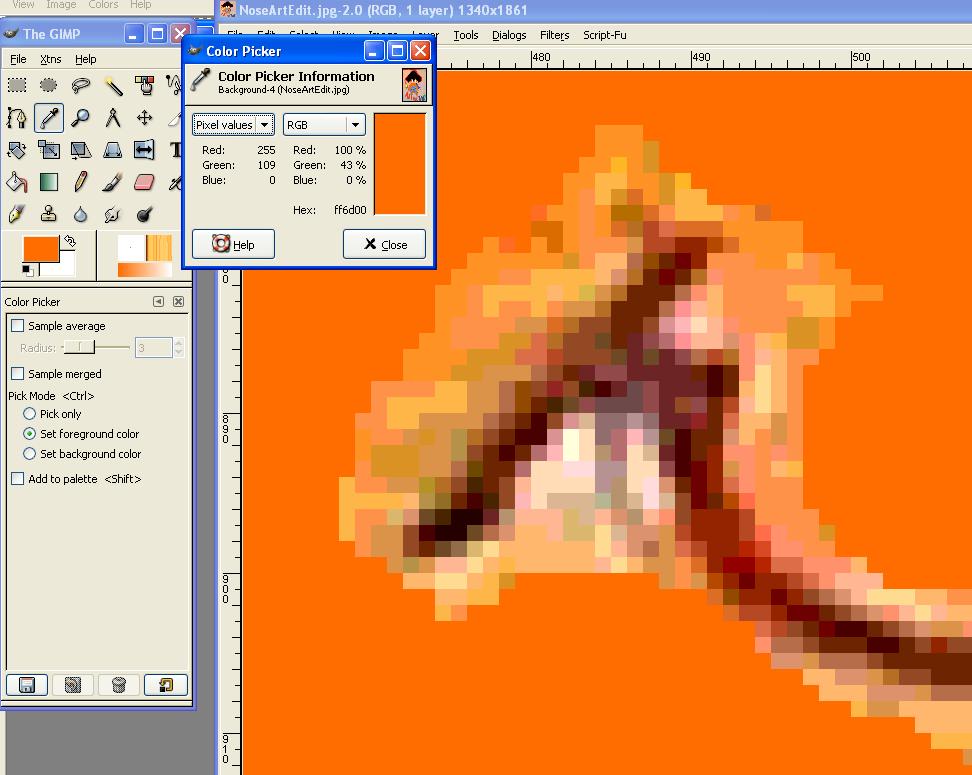
The first step was to get it digitized using the digital camera. That's what you see above. That was the easy step. The next step was to spend many, many hours making the colors crisp and solid. This necessitated a foray into the exotic and esoteric skills needed to work in a complex digital editing program named GIMP, which is a fantastically powerful tool in addition to its
best feature: it's free. Working at the molecular level (eg. pixels) was the only way to get the clean, crisp digital image that it would take to get a high quality image transferred onto a vinyl decal:


I didn't track the hours that it took, but it was a lot. Here's the latest cleaned up image:


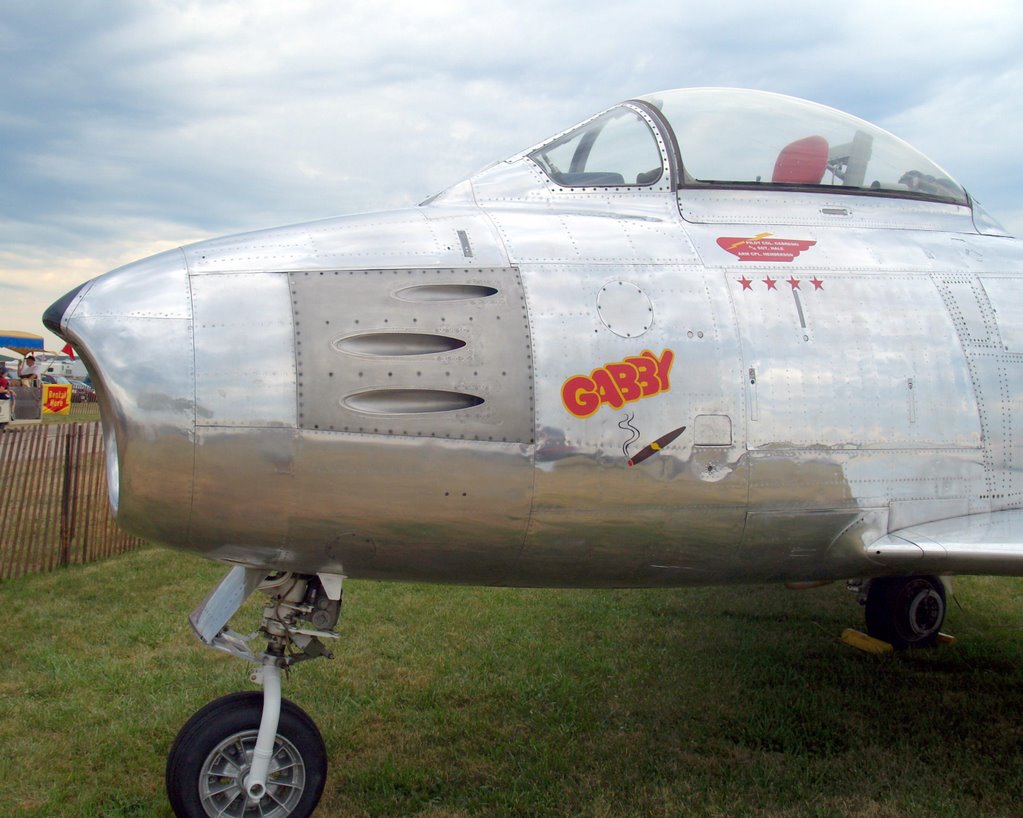
The next problem was to find a way to get the image transferred to a decal. I didn't exactly hunt for a service provider in the way a wolf hunts for comestibles, rather I used the watering-hole ambush method: when I saw an ad for an outfit that looked like it had this capability, I'd fire off an email asking if they could create a decal based on the image. This turned out to actually be theblackhole approach: questions went in, but nothing came out. Recently, however, I came across a referral on the Vans RV Forum and fired off yet another email. This one struck gold, and it now appears that the project is back on track. This prompted me to put a few more hours into cleaning up the image, and now that I have a nice color photo printer, I was able to print the results and see how they would look on the airplane:


The actual decal would be trimmed a lot tighter to remove the white background (and of course the bottom wouldn't be chopped off like that), and there would be two more gun ports on each side, for a total of six. The builder of the plane was more or less trying to create an F-86 look (albeit a taildragger F-86 (which doesn't actually exist) so I'm going to use three ports per side, just like the F-86 has:


I won't go to the bother of having two different sizes, though, and the grey background around the ellipse of the gun port would be trimmed off.

So, there's your update to the nose art saga.

Thursday, November 09, 2006

My new yardstick

If you never had a bad day, you'd have no standard (yardstick) to measure good days against, and today I got myself a new yardstick.

Let me start off by pointing out that I'm tired. Thursday afternoon is when the work - night school - work - work - night school - work cycle catches up with me, and I get very, very tired. But... when I see a clear blue sky and moderate temperatures (in NOVEMBER no less!!) I just have to fly. I wanted to gas up anyway in order to start my newly designed fuel log with a known quantity (i.e. full tanks), so I decided on a quick hop over the MadCo.

Preflight and start went well enough, although I was a bit surprised to see that I hadn't unplugged the preheater when the temperatures came back up early this week. I called the tower (they answered this time), gave the altimeter a nudge up to the 905 ft mark, taxiied out, and made a normal takeoff. On the way over to MadCo, I attempted a couple of recovery from unusual attitude exercises (you never know when you might run into some wake turbulence and one should always be prepared), but neither attempt was very good and I quickly gave up on that idea. Things were going fairly well other than that, although I did notice that I was having a little trouble with my radio communications, stumbling over my call sign and things like that.

As I was approaching MadCo's right downwind to runway 27, it felt like I was too low. Chalking that up to being a bit rusty, I proceeded into the pattern, and soon found myself on final. Final felt a little off too, as it seemed that even at 80 mph indicated things were happening very slowly. That, of course, was a result of the 10 - 13 knot headwind. The flare and touchdown were OK for a wheel landing (not my strong suit by any stretch of the imagination), but on rollout the nose took a frightening dip towards the runway. This was caused by the shoes I was wearing, which aren't my normal flying shoes. Rather than the light running-type shoes I normally wear, I was wearing clunky, heavy hiking boots. The brakes are pretty sensitive, and the bigger, bulkier shoes caused me to accidentally apply more brake than normal, and in the (for me) unusual attitude of a wheel landing, the unintentional extra braking caused the nose to dip precipitously. I easily recoverd by getting some weight off the brakes and a titch of back stick, though.

I pulled up to the pumps and parked next to a very nice RV-8 that was already there. Gas was $3.44/gallon, which is not too bad.

After tanking up and a brief chat with the RV-8 pilot (who had thankfully had been in the FBO paying for his fuel when I arrived and probably didn't hear my landing, during which I had squealed the tires so much that it sounded like a cat being pulled through a taffee machine), I decided that my icky landing called for a couple of stop & goes to get in some practice while we still had nice weather. At the end of the runway, a quick check of the altimeter to set UYFs field elevation showed me to already be at almost 2000 ft! Ah-ha! That explained why downwind had felt so low! The barometric pressure today was 29.72", and the altimeter was set at 30.72", which is nearly 1000' off. The pressure on Saturday when I flew last must have been almost exactly an inch higher than today, and when I nudged the altimeter up to 905', I didn't notice that it was actually 1,905'. D'oh! Another rookie mistake! Yawwwnn.

After two acceptable stop & go landings, it was time to head back to Bolton. The routine of configuring the plane for the various flight modes and the management of other little tasks had come back to me pretty quickly despite having not flown much recently and the plane felt great in the air, but I still managed to bounce the landing back at Bolton to the degree that I needed a quick burst of throttle at the apex of the bump to recover the landing. It was pretty windy, though, and wind is always a great catch-all excuse, often cited as being culpable for a multitude of sins. Surely an exuberant bounce on landing can be attributed to a 10 knot wind, can't it? And it was a crosswind too, after all.

Back in the hangar, I yawned mightily and decided that if nothing else, I got some good practice in today, and set the bar low enough that there's no way my next flight can't be an improvement. But here's the best part: it was still a blast and left me smiling! Having a couple of sub-par landings in an RV is like a golf pro hitting a couple of bogies at Augusta: it's mildly disappointing, but you're still damn glad just to be in the game.

Saturday, November 04, 2006

A flight made distinctive by its atypicalness

Or is it atypicality? Or atypicalitude? Most likely, its none of the preceeding and you really can't get there from here. Let's just stipulate that there was something between 'slightly weird' and 'abnormal' about flying today.

After a few weeks layoff there's always going to be a little bit of surface rust on the skill set, but it's normal, expected, and not difficult to deal with. Today dawned with clear skies and a manageable wind, but the look in the hound's eyes when presented with his first potty break opportunity of the day said it all: it's cold out there! The frost on the grass confirmed his assessment, so I knew I was going to have to dress warm unless I wanted to get my winter temperature acclimation completed in one sitting. I bulked up with long underwear and a long sleeve shirt, grabbed my RV hoody sweatshirt, and what with it being a game day, topped it all off with my OSU jacket. I have an ancient bomber jacket that's nice and warm, but it's too bulky for the airplane, so I find it's better to dress in layers. If I may butcher a metaphor, the problem with an airplane that fits me like a glove is that the glove gets pretty tight when my hands are swollen. Even with just the longies, sweatshirt, and jacket, I struggled to get the safety belts situated and found that I had to slouch a bit once the canopy was down.

A weather check indicated an ambient temperature of 25 degrees, so it was a good thing that I had remembered to stop by the hangar Friday and plug in the engine pre-heater. I had also looked over the plane while I was there because through experience I have learned that the two keywords for 25 degree flying are "perfunctory" and "pre-flight." Having gone over the plane yesterday, I was pretty comfortable with the "Wings: attached. Tail: attached. Propellor: attached. Ass: frozen off and lying on the tarmac." style of preflight. The engine pre-heater does a great job, and even after a weeks long layoff she started right up after just one blade.

By this time it was right in the middle of the zone-of-confusion that surrounds the control tower being open or closed. The schedule is for the tower to open at 0730. Anytime between 0725 and 0735, I'm never absolutely certain what the status is. I have a scanner in the hangar that lets me hear the tower, so I turned that on as I did my preflight. The tower makes an announcement when they open, so catching that would negate the uncertainty. Nada. A couple of minutes later I was in the plane and had the radios on. My watch was within a minute of 7:30, so it was possible that I missed the announcement. Discretion being the better part of lots of things (valor is overrated anyway), I called ground control for taxi clearance. Nothing. Ok, I can go pretty much all the way to the ramp without their permission anyway, so I went ahead and got rolling. I called them a couple of more times on the way, but no response. Once clear of the hangars, I could look at the tower and see that there was no one up there, and it was still only a couple of minutes beyond 7:30 anyway so it was certainly within the bounds of possibility that my watch was fast or theirs was slow. Normally, being able to see the tower would be all I'd need. If the tower is closed, the green and white rotating beacon will be on. Today, however, I saw in the NOTAMs (Notices to Airman) of the preflight weather briefing I got before I left home that the rotating beacon was out of service. Since it was plain to see that there were no other planes in the area and that the tower cab was uninhabited, I decided to go ahead and taxi on down to the runway. I called again at the end of the runway, but when there was no response I just transmitted my intentions to any local traffic (which is normal for when the tower is closed) and went.

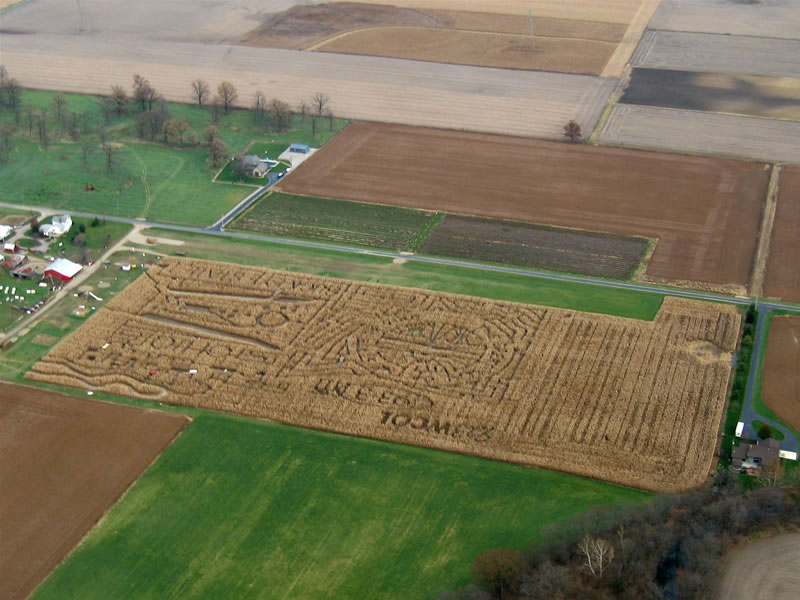
The climbout was glass smooth and the visibilty was about 10 miles in a light haze. It would have been lousy photography lighting, which is good considering that I had forgotten to bring the camera. Still, I'm kicking myself for not getting even a mediocre picture of the corn field with the seal of the State of Ohio and an Ohio flag cut into it that I flew over. If it's nice tomorrow morning, maybe I'll go back to get a shot ot two. It's only 19.4 nm NW of here.

UPDATE:
Some people actually do remember to bring their cameras. Brandon took this shot on his way back from Columbus to Lima:
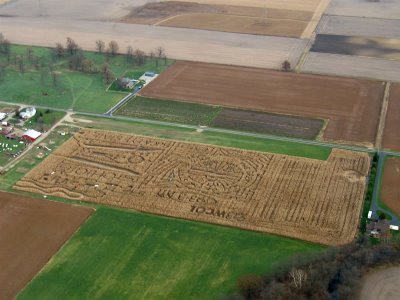

Photo by Brandon D. Wren, all rights reserved.

Along the way I dialed up 122.7 to see what was going on at Allen Co., but the skies were apparently empty at 07-early on a frigid morning. A few minutes later, though, voices starting popping up and it quickly got busy. This caused me to wonder if perhaps there had been a problem with my radio that precluded communications with the tower. Hmmm. Still, it had been quite plain to see that there was no one in the tower cab. Oh well, water under the bridge and I had a pending landing to think about anyway.

The destination today was Lima/Allen Co. airport to have a breakfast visit with the world-record holder for the briefest time to be an RV-4 owner. The runway there is 09 - 27, and I knew the winds were at least southerly. That means I would be facing a nearly direct (perpendicular to the runway) crosswind on my first landing in weeks. The only real remaining question was how much crosswind. Allen Co. has an AWOS automated weather system, but it transmits on a Nav frequency and I don't have a nav receiver in the plane. Fortunately I bought that nifty AnywhereMapWX at Oshkosh. A quick tap of the stylus and I had the winds from Allen Co: 180 @ 9. Direct crosswind, but within my normal limits. It was a bit more than what had been forecast for nearby Findlay, but not to an eyebrow raising degree. I had about a 15 degree crab coming down final, and as I transitioned into the flare I was able to straighten it out to align with the runway with about a half boot of right rudder. A little compensatory left bank into the wind kept me tracking right down the middle of the runway, and the whole thing ended with a nice, smooth touchdown, which is a rare enough occurence under the best of condtions that I had to congratulate myself.

Upon leaving after a few too many cups of coffee to ensure a completely comfortable trip, I briefly thought about using runway 9 instead of 27. When taking off with a crosswind from the left, it takes quite a bit of right rudder to counteract the weather-vaning tendency of the plane to turn into the wind, and combined with the normal leftward pull of the engine and propellor, we're talking about a comparatively high demand for right rudder. By using runway 9, the crosswind would be from my right, which typically results in a takeoff that requires no rudder whatsoever. Alas, 'twas not to be. There was a Mooney practicing ILS approaches to runway 27 and the benefit of a slightly easier takeoff is not outweighed by the risk of flying directly into opposing traffic.

The takeoff was fine, and good practice. The flight home was marred only by the tenatious internal questions about what kind of reception I might receive. More than likely, I'd breeze right in as if nothing happened, because nothing did. But that nagging idea that my radio may have been the culprit rather than a slightly tardy controller or an inaccurate time setting on my watch had me wondering if I might receive a cooler reception and a request to have a chat after landing. Preparing for the worst, I tuned in the tower as soon as I was clear of Allen Co. to see if I could get a feel for the controller's mood:

"Uh-oh. It's Mr. Grumpy, the controller that's so petty and snippy that an air traffic controller I was flying with once commented on it. Well, maybe he's in a good mood."

"Uh-oh, he's worse than normal! He's barking at a touch-and-go'er for not repeating clearances in under 3 seconds. Dude! Lighten up!"

"Ah, this could be a help. The pattern's pretty busy and he may not have the time to scold me."

I get closer:

"Geez, where'd they all go? The one time I want a crowded pattern..."

Me: "Bolton tower, experimental four-six-six-papa-golf over Darby Dan, inbound full stop."

Tower: "Four-six-six-papa-golf, report two mile right base, 22."

Me: "Bolton tower, six-papa-golf two mile right base"

Tower: "Six-papa-golf not in sight, cleared to land."

Pretty good landing, albeit again with a direct crosswind. Funny how the wind shifted just enough between Lima and Columbus to ensure the worst case at both locations. Then:

Tower: "Six-papa-golf turn right alpha-three monitor ground on point eight taxi to park"

Me: "Right alpha three, monitor ground." "Whew. Glad that's over!"

Monday, October 30, 2006

Project Valour-IT

You will see a new link over on the right side of the page for Project Valour-IT. Here's a description of the program:

Project Valour-IT
(Voice-Activated Laptops for OUR Injured Troops)
In memory of SFC William V. Ziegenfuss

Every cent raised for Project Valour-IT goes directly to the purchase and shipment of voice-activated laptops for wounded servicemembers. As of October 2006, Valour-IT has distributed nearly 600 laptops to severely wounded Soldiers, Sailors, Airmen and Marines across the country.

During its initial phase, Valour-IT created "libraries" of laptops equipped with voice-controlled software for the severely wounded staying at major military medical centers. In many cases a laptop was provided to a wounded hero for permanent use.

Valour-IT is continuing to accept donations of any amount to supply the "libraries" of laptops at major medical centers and gifts to individuals, but has also added the option of an individual or organization directly sponsoring a wounded soldier by completely funding the cost of a laptop and continuing to provide him or her with personal support and encouragement throughout recovery. This has proved to be an excellent project for churches, groups of coworkers or friends, and members of community organizations such Boy Scouts.

Most recently thanks to the efforts of the Military Order of the Purple Heart, Valour-IT is now able to reach personnel in VA hospitals who would benefit from a Valour-IT laptop.


I chose to champion the USAF since I spent 5 years active duty in the Air Force, three of which were overseas assignments, and then spent another 6 years in the Ohio Air National Guard. I considered selecting the Army or Marines, but they were already well represented. It's all for a good cause, though, so you can't go wrong with contributing to any of the service members.

Why don't he write?

Admit it: we all have our own version of the crude, crass movie line that despite of its misanthropy we still laugh at every time we see it. For me, my guilty little piece of movie dialog comes from Dances With Wolves. The crazy wagon driver comes across a skeleton out on the prairie, and speculates that "someone back East is wondering why she don't write." Cruel, thoughtless, yet it still makes me chuckle every time I hear it, albeit mostly because of the way the line is delivered rather than any inherent comedic value.

So, why don't I write? Well, mostly because for the second weekend in a row I haven't been able to fly. Yesterday was nice enough from a sky and visibility point of view, but the winds were gusting over 20 mph and I just won't fly my taildragger when it gets that gusty. I'm a bit of a sissy that way.

I managed to fill the time quite nicely with winterization chores around the house, and fortunately there wasn't much air traffic in or out of Bolton to taunt me. I think I'm not alone in considering 20 mph winds too much for a safe and comfortabel flight. I'm not saying it can't be done, mind you, and I have in fact landed the Tampico in a direct 25 knot crosswind, but the risk vs. benefit analysis iw weighted more towards just staying home on windy days since I moved to the taildragger.

Now that the days are getting shorter, it's going to become increasingly difficult to even work in a short flight after work. I hate this time of year.

Monday, October 23, 2006

What is it??

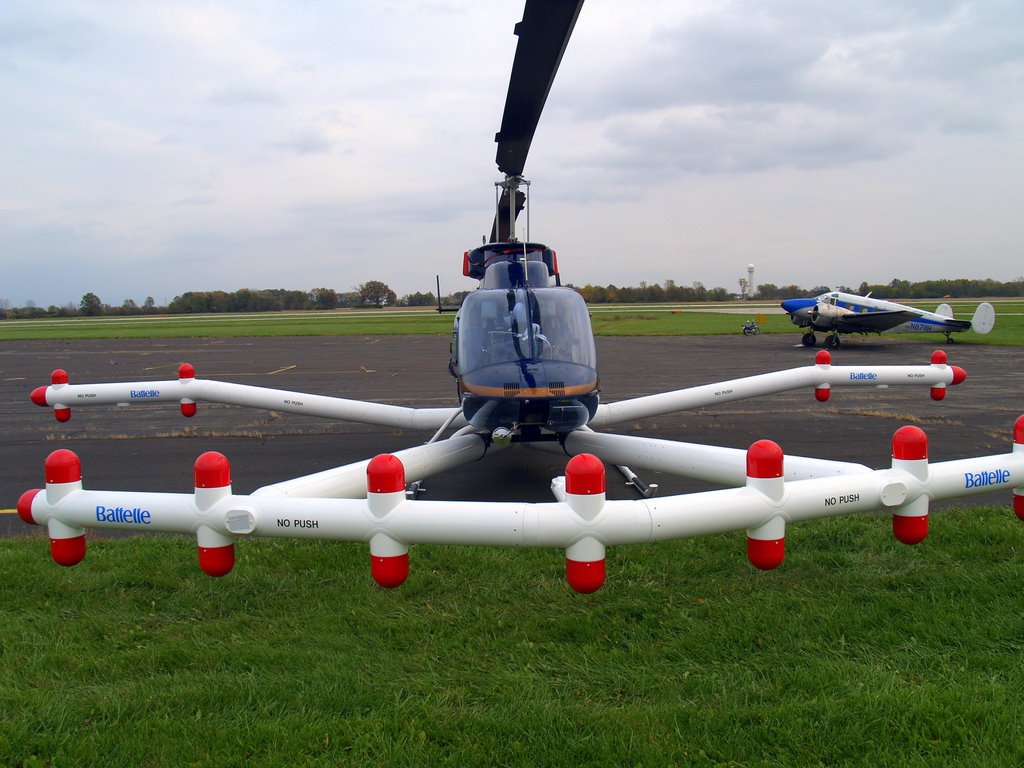
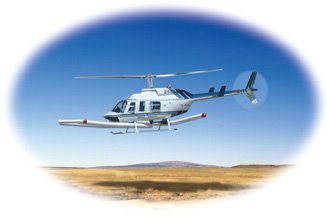
I've seen this thing flying around Bolton for a few days now, and this afternoon I got a few minutes to take a closer look:


All I can find on Google that's even remotely similar is this:


Airborne UXO Detection

The numbers reach the tens of millions in both acres and dollars. And the standard operating procedure literally has been pedestrian. Until now.

A team of researchers in a newly opened Battelle office in Oak Ridge, Tenn., is tackling the problem of UXO—unexploded ordnance—buried in an estimated 15 million acres of land and consuming upward of $200 million in cleanup costs each year.

The Battelle team has developed and refined several airborne systems for detecting UXO using magnetic fields, electromagnetic induction and global positioning systems. The technologies are essentially flying metal detectors.

Mounted on a commercial helicopter, the equipment is a rigid fixed boom configuration that has the capability of delivering data analysis, digital maps and target lists within hours. Battelle’s detection system has eight sensors, or magnetometers, and a sampling frequency of 1,200 hz, which yields a high density of data. To get the most specific data possible, the distance between the system and the ground is kept between one to three meters.

After a quick pass by the helicopter, the system is able to detect different sizes of munitions, all the way down to 60mm shells. That’s comparable to the capability of ground-based systems, but not nearly as time consuming or dangerous.


This must be either a newer version, or something similar but different. (And yes, that is what passes for deep insight and stellar grammar after a full day of work and a night at A&P school. Just consider yourself lucky that I haven't gotten to the beer yet!)

Friday, October 20, 2006

Best use of spare instrument space?

UPDATE: I've decided that I need a combo EGT/CHT emgine monitor, and that I will buy it from someone other than JPI. I did a little research and it didn't take long to find their abysmal reputation for customer support and some of their more heavy-handed legal tactics. I have no patience for that kind of thing, so will look elsewhere for what is in essence a commodity product. It amazes me that a company making a product that is easily available from a competitor at the same price point doesn't realize (or care) what a bad reputation can do to them.

Original post:

Since I moved by mag compass to a new location in the panel, I have an empty 3 1/8" instrument hole to fill. My first thought was to put in a g-meter, but given the type of flying that I do, there's no real need for it.

One need I do have, however, is in the realm of engine management. I do not have any temperature gauges whatsoever, other than oil temp which is nearly a constant anyway.

The two possible engine temp gauges under consideration are either cylinder head temp (CHT) or engine exhaust temp (EGT). My understanding (and please, chime in with a comment if you disagree) is that EGT is more useful in determining the best mixture to set than CHT. Assistance in setting the appropriate mixture is primarily what I'm after, so unless a strong counter argument can be made for monitoring CHT instead, I'm planning on installing an EGT gauge.

Of course, if I were willing to spend the money, I could have both, but graphic engine monitors that display both EGT and CHT are pretty expensive. If I choose to do only EGT, it will be quite a bit cheaper, and I'm not convinced that I need both. Again, chime in if you disagree.

In any event, if I go with EGT, I want it on every cylinder. Leaning based on the EGT of a single cylinder seems pretty risky.

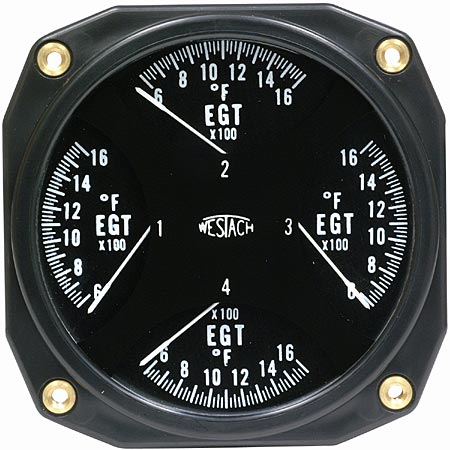
So, with all that said, here is the gauge I'm looking at:


With all four probes, it's going to be nearly $400. A graphical engine monitor that provided both 4 cylinder EGT and CHT is about $1000 more:

http://www.aircraftspruce.com/catalog/inpages/gem1.php

I think I will get what I need from the lower cost alternative, but I can still be persuaded.

UPDATE:

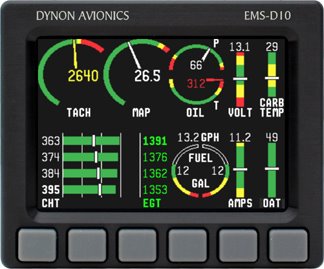
Another option:


I'll have to measure, but I think I have the required space behind the panel for it to fit. But at $2300 for the display and probes, it definitely blows the budget all to heck.

I looked at the JPI and EI units, but they are all 2-1/4" units, and I'd really like to completely fill the 3-1/8" hole. I'm not ruling out one of the smaller units, though, as I imagine I'd get used to it pretty quickly.