I hopped over to MadCo to tank up after flying on both Saturday and Sunday last weekend. It was a nice afternoon, although the 10 knot crosswind from the east warranted just a bit more rudder play than had the air been calm. Being what ultimately turned out to be 17.1 gallons (that precise value having been determined at the rate of $4.07 per, alas) lighter on the way over to MadCo, Papa and I took the opportunity frolic a bit before we loaded up on gas.
On the way back, I called the tower at my usual western side reporting point, and received the expected "report two mile left base for runway 4." Having done so, and made my turn to final, I heard one of the FBO rental 172s call in a few miles south. This also prompted a standard call for planes approaching from the south: "Report two mile right base runway 4." There was a brief pause, then what must have been the instructor called back and requested a straight in approach to 4.
This request seemed eminently reasonable to me, having asked the same myself many times in the past. Back when I had the Tampico, landing on 4 meant that I could exercise the ILS skills and hardware, albeit while being able to see the runway the entire time. Still, it was always interesting to see how the localizer and glideslope aligned with the visual approach. I was surprised, therefore, to hear the tower respond with a sarcastic "then I guess you weren't to the south after all, you must have been southwest."
With that in mind, I'm not clear how it could have been inferred from the request for a straight in that the plane was not where they said it was, actually, since all he really knew was that the plane in question was reportedly to the south, not what direction it was headed. One could assume that they were headed due west in order to pick up the ILS to runway 4, or one could guess that they were headed directly towards the airport and would thus already be lined up for the extended right base. The best assumption, in my opinion, would have been that the pilot had a reason for the request and that it should be approved if able, or denied if not. That would have been more reflective of what I believe the proper relationship between the pilot-in-command and the controller should be.
Apparently the instructor agreed. "We were right on the border of south or southwest. Come on." That last bit being inflected with more than a tad of derision, constituting an unmistakable and well deserved "get over it." They were approved for the straight in with no further discussion or delay.
I just kinda chuckled as I taxied back to the hangar. I love this stuff!

Friday, June 15, 2007

Monday, June 11, 2007
On being a wingman
This is from a blog named Neptunis Lex, and the series of posts I extracted this from is, like the rest of the blog, well worth your time:
There was a point in his speech to us when Stratton talked about the qualities he wanted in a “good wingman” - I forget exactly those he enumerated, because he summarized them thus: “If I ever find myself coming out of the weather and about to run into a mountain, the last thing I want to see as I blow up is my wingman augering in right beside me.”
I have to admit that as a young man, it seemed a bizarre image. Wouldn’t it have been better I thought, if maybe the last thing would have been the wingman hollering, “Pull up!”?
I didn’t understand - there was still so much for me to learn.
Although our language would always be different, in time I came to appreciate what the good captain was saying about a good wingman - and it seems such faint praise to label someone a “good wingman,” doesn’t it? To the uninitiated it seems almost a left-hand compliment, as though being a good wingman meant that one was personally incapable of leading.
Nothing could be further from the truth.
A man who flies the jet well may be known as a “good stick,” but this will be thought little more than the grace that God has given him. He may be a called a “good ball flyer” for his skill landing aboard ship, but that is a merely technical skill, admirable enough in its own way, but not particularly special - as at any skill, some will always be better and others worse. To be known as a “good wingman” however is another thing entirely.
A good wingman is a pearl beyond price.
A good wingman is intelligent and disciplined, in the air and on the ground. He knows his machine and the mission he’s fragged for because he’s prepared himself - he doesn’t need to be spoon fed. He knows that it is the lead’s responsibility to develop the plan, and the wingman’s responsibility to support it, so he listens carefully in the brief, and he visualizes the lead’s guidance - he can see it all coming together. If there’s a part he doesn’t get, he’ll ask right there and then, knowing that once he’s in the air, with bandits airborne, the target approaching, the radar warning receiver warbling in his headset, the blood singing in his veins and smoke trails reaching out and weaving through the cobalt blue skies, the time for questions is irretrievably past.
He knows that once he walks out of the ready room and stepped towards the flight deck he has officially passed the GICOT - the “good idea cut-off time.” From that point on he will fly the brief as it was delivered - he will be predictable, for his lead will have much to concern himself with and cannot afford for his wingman to be part of those concerns.
If events unfold in such a way that the brief is proved to be in some way insufficient, he’ll listen up for the lead to call audibles and only then offer suggestions if none are forthcoming. If the lead doesn’t respond or isn’t capable, the wingman will fly wing satisfied, if not entirely content, in the knowledge that perhaps it was a good day to die. Which is what I think CAPT Stratton was saying, back in the fall of 1978.
But these are only pre-requisites - necessary, but not sufficient.
To be a truly good wingman, one cannot merely be a good follower - one must place oneself inside the lead’s cockpit. Understand what he understands, know what it is he’s thinking, predict what he will do even before he asks it. Because a good wingman will, like a computer that plays chess, analyze every possible move, rank and order them according to probability and - knowing the mission, knowing the brief, knowing the lead - anticipate his desires. When the order does comes - whenever and whatever it is, briefed or unbriefed - a good wingman will execute as quickly and indeed joyfully as though the lead had done it for him.
It is very hard to be a good wingman, and an honor to be known as one.
My basis of experience is admittedly infinitesimal after only two efforts at wingmannery, so I may not be qualied to say that this is the coolest and best description of what it means to be a wingman ever written, but still... it rocks!
There was a point in his speech to us when Stratton talked about the qualities he wanted in a “good wingman” - I forget exactly those he enumerated, because he summarized them thus: “If I ever find myself coming out of the weather and about to run into a mountain, the last thing I want to see as I blow up is my wingman augering in right beside me.”
I have to admit that as a young man, it seemed a bizarre image. Wouldn’t it have been better I thought, if maybe the last thing would have been the wingman hollering, “Pull up!”?
I didn’t understand - there was still so much for me to learn.
Although our language would always be different, in time I came to appreciate what the good captain was saying about a good wingman - and it seems such faint praise to label someone a “good wingman,” doesn’t it? To the uninitiated it seems almost a left-hand compliment, as though being a good wingman meant that one was personally incapable of leading.
Nothing could be further from the truth.
A man who flies the jet well may be known as a “good stick,” but this will be thought little more than the grace that God has given him. He may be a called a “good ball flyer” for his skill landing aboard ship, but that is a merely technical skill, admirable enough in its own way, but not particularly special - as at any skill, some will always be better and others worse. To be known as a “good wingman” however is another thing entirely.
A good wingman is a pearl beyond price.
A good wingman is intelligent and disciplined, in the air and on the ground. He knows his machine and the mission he’s fragged for because he’s prepared himself - he doesn’t need to be spoon fed. He knows that it is the lead’s responsibility to develop the plan, and the wingman’s responsibility to support it, so he listens carefully in the brief, and he visualizes the lead’s guidance - he can see it all coming together. If there’s a part he doesn’t get, he’ll ask right there and then, knowing that once he’s in the air, with bandits airborne, the target approaching, the radar warning receiver warbling in his headset, the blood singing in his veins and smoke trails reaching out and weaving through the cobalt blue skies, the time for questions is irretrievably past.
He knows that once he walks out of the ready room and stepped towards the flight deck he has officially passed the GICOT - the “good idea cut-off time.” From that point on he will fly the brief as it was delivered - he will be predictable, for his lead will have much to concern himself with and cannot afford for his wingman to be part of those concerns.
If events unfold in such a way that the brief is proved to be in some way insufficient, he’ll listen up for the lead to call audibles and only then offer suggestions if none are forthcoming. If the lead doesn’t respond or isn’t capable, the wingman will fly wing satisfied, if not entirely content, in the knowledge that perhaps it was a good day to die. Which is what I think CAPT Stratton was saying, back in the fall of 1978.
But these are only pre-requisites - necessary, but not sufficient.
To be a truly good wingman, one cannot merely be a good follower - one must place oneself inside the lead’s cockpit. Understand what he understands, know what it is he’s thinking, predict what he will do even before he asks it. Because a good wingman will, like a computer that plays chess, analyze every possible move, rank and order them according to probability and - knowing the mission, knowing the brief, knowing the lead - anticipate his desires. When the order does comes - whenever and whatever it is, briefed or unbriefed - a good wingman will execute as quickly and indeed joyfully as though the lead had done it for him.
It is very hard to be a good wingman, and an honor to be known as one.
My basis of experience is admittedly infinitesimal after only two efforts at wingmannery, so I may not be qualied to say that this is the coolest and best description of what it means to be a wingman ever written, but still... it rocks!
Sunday, June 10, 2007
I could be a Kennedy: My own taxpayer-provided private lakeside airport
It was another beautiful day for flying, but as fate would have it, it was also a beautiful day for cleaning out the garage, tending to a few landscaping details, and washing the Miata. It wasn't until all of that was done and a quick lunch was wolfed down that I was able to think about flying, but that was actually still pretty early in the afternoon. It's been awhile since I've been out to Noble County, so that seemed as good of a place as any for flight that was intended to be more about the journey than the destination. It's only about 65 nm away as the GPS flies, although I add a few miles by shifting a little south to avoid the Columbus Class C airspace.
The light winds were from the northeast, so we had the long taxi down to rwy 4 for takeoff. There are a few wooded acres on Bolton Field, and every once in a while we get treated to some wildlife. I've seen more coyotes than deer, but the score between the two tightened up a little bit today:

I wanted to stay down low where the effects of any headwind would be less, so I only climbed to 3,500' (a little bumpy, what with the afternoon sun having had a chance to roil things up) where I found that I could only scare up 145 knots. I was wondering where the stronger than expected headwind was coming from when I remembered that I had left 8 knots sitting back in the hangar in the form of broken wheel pants. I need to get that darn thing fixed soon.
Noble County (I10) is one of those airports that makes you want to sacrifice a goat or something to honor whoever the greek god of GPS is. I've been there a number of times before, and just like on all of those previous trips, I didn't see the airport until I was right on it. The GPS makes things like that sinfully easy to deal with, though, so I already had Papa slowed down (not all that hard to do sans pants, as it turns out) to pattern speed when the airport finally peeked up behind the hills:


Here's another for my Fly Ohio collection:

I usually park in the grass tie down area and walk down the path to the lake. It's only a 1/4 mile or so, and the path is kept well cleared. Once you get into the woods, the sounds of the highway just west of the airport fade away and you're left with nothing but the sounds of bugs and birds. I've never seen another airplane there, nor any other signs of bipedal life. It's like having my own private lakeside airport. The best thing about it is the complete isolation and solitude. Of course, that's the worst thing about it too - I've seen Deliverance. Funny how things like that stick with you and pop into your head at the oddest times, isn't it? Still, it's a nice walk down to the lake:


This reminded me that my kayak kit should arrive early next week:

Here's what you're looking at when departing on rwy 5:

It's nice that it's down hill, but there's a bit of a harsh penalty at the end if you run off. The Lycoming didn't let me down, so I maximized the tail wind and got a bit of cool air by climbing up to 6,500' for the trip back.

That was high enough to be well over the top limit of the Columbus airspace, so it was a straight shot back to Bolton, albeit with a pretty rapid descent to pattern altitude once clearing Rickenbacker's Class D. Landings were fine today, but nothing special - probably scoring at around 6 to 7 each. The first was a little bouncy on the downhill runway at Noble Co., and the second was the kind where I get a little high on the flare over the fatter runway at Bolton and just end up holding a 3 point attitude until I can plop it onto the concrete. Good enough.
The light winds were from the northeast, so we had the long taxi down to rwy 4 for takeoff. There are a few wooded acres on Bolton Field, and every once in a while we get treated to some wildlife. I've seen more coyotes than deer, but the score between the two tightened up a little bit today:

I wanted to stay down low where the effects of any headwind would be less, so I only climbed to 3,500' (a little bumpy, what with the afternoon sun having had a chance to roil things up) where I found that I could only scare up 145 knots. I was wondering where the stronger than expected headwind was coming from when I remembered that I had left 8 knots sitting back in the hangar in the form of broken wheel pants. I need to get that darn thing fixed soon.
Noble County (I10) is one of those airports that makes you want to sacrifice a goat or something to honor whoever the greek god of GPS is. I've been there a number of times before, and just like on all of those previous trips, I didn't see the airport until I was right on it. The GPS makes things like that sinfully easy to deal with, though, so I already had Papa slowed down (not all that hard to do sans pants, as it turns out) to pattern speed when the airport finally peeked up behind the hills:


Here's another for my Fly Ohio collection:

I usually park in the grass tie down area and walk down the path to the lake. It's only a 1/4 mile or so, and the path is kept well cleared. Once you get into the woods, the sounds of the highway just west of the airport fade away and you're left with nothing but the sounds of bugs and birds. I've never seen another airplane there, nor any other signs of bipedal life. It's like having my own private lakeside airport. The best thing about it is the complete isolation and solitude. Of course, that's the worst thing about it too - I've seen Deliverance. Funny how things like that stick with you and pop into your head at the oddest times, isn't it? Still, it's a nice walk down to the lake:


This reminded me that my kayak kit should arrive early next week:

Here's what you're looking at when departing on rwy 5:

It's nice that it's down hill, but there's a bit of a harsh penalty at the end if you run off. The Lycoming didn't let me down, so I maximized the tail wind and got a bit of cool air by climbing up to 6,500' for the trip back.

That was high enough to be well over the top limit of the Columbus airspace, so it was a straight shot back to Bolton, albeit with a pretty rapid descent to pattern altitude once clearing Rickenbacker's Class D. Landings were fine today, but nothing special - probably scoring at around 6 to 7 each. The first was a little bouncy on the downhill runway at Noble Co., and the second was the kind where I get a little high on the flare over the fatter runway at Bolton and just end up holding a 3 point attitude until I can plop it onto the concrete. Good enough.
Saturday, June 09, 2007
New banner picture: please vote!
I think it's time for a new banner, or maybe not. I thought I'd let you vote, so just let me know what you think in the comments. So, here are the candidates:
New banner #1:

New banner #2:

New banner #3 (provisional winner):

And Rick, don't be voting for #1 just because you're in it.
I took these this morning at Urbana Grimes. Urbana is pretty neat as you never know what you may find there on any given day, and it is a matter of historical record that the "always take your camera" rule was initially conceived on the day I landed there and missed the chance to get some pictures of a transient B-17. It's nice to arrive to the presence of a B-25 on the ramp, and it's doubly pleasant to arrive and find two, as we did today. Having not violated the camera rule today, I was able to get these:


I'm not sure why all of my pictures this morning seemed to be of guns, to be honest. I hope it's not some kind of subliminal warning thing, although I guess I could live with a Freudian type of thing if it comes to it!
The trip over had been nice, with clear, clear air and a cloudless sky. Just the kind of morning that gets your spirit up, and may even induce you to try something a little out of your routine, like landing on Urbana's grass runway. Besides the fun of announcing that you're landing on runway 1 when simply everybody knows that the runway at Urbana is 2 and smirks in their headsets, you get to land on grass, which is just cool. So, that's what I did. And bounced it. To the degree that I needed a wee bit 'o power to smooth it out. The result of pranging the wheels down on the rock hard dirt of rain-starved Union County was evidenced after breakfast when I pulled the plane forward out of my prime RV-only parking spot right outside the restaurant windows.
There's always a little bit of noise from the brake pads lightly riding across the discs, but this time the sound coming from the left wheel was much louder than normal. I crawled under the wing to take a look and found that the lower inside part of the wheel fairing had been broken and pushed up inside the fairing where it was rubbing against the tire. The 'tab' pulled out easily enough and rested nicely on the outside of the wheel opening, so it was easy enough to just go back to Bolton and remove both of the wheel fairings. Darn things are more trouble than they're worth if you're landing on grass, I suppose, but I'm going to miss the extra 8 - 10 knots.
Next stop was Coshocton (I40), and other than the nicely priced gas ($3.55!!), there really isn't much to talk about. Fellow RVers were in and out, so we enjoyed visiting for a couple of hours, then headed home. Here's another quiz before we're done, though: true or false, is it possible to get in to this airplane, fasten the belts, lower the canopy, start the engine, and be just moments away from trying to taxi without having removed this chock?

Sadly, the answer is 'true.'
Piloting tip #32: if you find yourself in this situation, save face thusly: shut down the engine, walk all the way back across the ramp and tell everyone that you just had to come over and say hello to [insert most recently arrived RVer] before you could leave. It works, trust me.
New banner #1:

New banner #2:

New banner #3 (provisional winner):

And Rick, don't be voting for #1 just because you're in it.
I took these this morning at Urbana Grimes. Urbana is pretty neat as you never know what you may find there on any given day, and it is a matter of historical record that the "always take your camera" rule was initially conceived on the day I landed there and missed the chance to get some pictures of a transient B-17. It's nice to arrive to the presence of a B-25 on the ramp, and it's doubly pleasant to arrive and find two, as we did today. Having not violated the camera rule today, I was able to get these:


I'm not sure why all of my pictures this morning seemed to be of guns, to be honest. I hope it's not some kind of subliminal warning thing, although I guess I could live with a Freudian type of thing if it comes to it!
The trip over had been nice, with clear, clear air and a cloudless sky. Just the kind of morning that gets your spirit up, and may even induce you to try something a little out of your routine, like landing on Urbana's grass runway. Besides the fun of announcing that you're landing on runway 1 when simply everybody knows that the runway at Urbana is 2 and smirks in their headsets, you get to land on grass, which is just cool. So, that's what I did. And bounced it. To the degree that I needed a wee bit 'o power to smooth it out. The result of pranging the wheels down on the rock hard dirt of rain-starved Union County was evidenced after breakfast when I pulled the plane forward out of my prime RV-only parking spot right outside the restaurant windows.
There's always a little bit of noise from the brake pads lightly riding across the discs, but this time the sound coming from the left wheel was much louder than normal. I crawled under the wing to take a look and found that the lower inside part of the wheel fairing had been broken and pushed up inside the fairing where it was rubbing against the tire. The 'tab' pulled out easily enough and rested nicely on the outside of the wheel opening, so it was easy enough to just go back to Bolton and remove both of the wheel fairings. Darn things are more trouble than they're worth if you're landing on grass, I suppose, but I'm going to miss the extra 8 - 10 knots.
Next stop was Coshocton (I40), and other than the nicely priced gas ($3.55!!), there really isn't much to talk about. Fellow RVers were in and out, so we enjoyed visiting for a couple of hours, then headed home. Here's another quiz before we're done, though: true or false, is it possible to get in to this airplane, fasten the belts, lower the canopy, start the engine, and be just moments away from trying to taxi without having removed this chock?

Sadly, the answer is 'true.'
Piloting tip #32: if you find yourself in this situation, save face thusly: shut down the engine, walk all the way back across the ramp and tell everyone that you just had to come over and say hello to [insert most recently arrived RVer] before you could leave. It works, trust me.
Saturday, June 02, 2007
The Dog Days of June
We have pretty much the same hazy, muggy August-like weather we've had for a couple of weeks now, although August is still quite a bit away. With the possibility of thunderstorms in the afternoon, and the 100% certainty that it was only going to get hotter as the day progressed, I decided on a morning hop down to Highland Co. to have a walkabout around Rocky Fork State Park. Winds on departure were dead calm, with clear skies and about 5 or 6 miles visibility. I cruised down to Hillsboro at a leisurely 2200 RPM, finally, after two years in the RV, beginning to break the habit of flying everywhere at full throttle that I developed in my 5 years of flying the 100 knot Tampico. Even at 2200 RPM in the RV-6 I get a nice 135+ knots and I was, after all, in no real hurry.
Highland Co. is typical of an Ohio county airport: a lot of slope on the runway. The automated weather system was reporting calm winds there as well, so I had my choice of runway. Coming from the north as I was, it was more expedient to enter a left downwind for runway 5, although that isn't my favorite way to land there as it is a downhill slope on the runway. That can be tricky in the flare, but with the calm air I was able to make a decent touchdown, and I got down early enough to still make the turnoff right in front of the parking area.
I parked the plane, gathered up my camera equipment, and headed for the gate to walk the half mile or so down to the lake. Parked over by the fuel pumps was this gorgeous Piper Cub:


I like the horn, and wish I could put something similar on the RV. Why, you ask? Well, some of the renters at the Bolton FBO are pretty cavalier with regards to where they park the airplanes, and it's not uncommon to have the taxiway blocked by a Skyhawk. Many's the time that I've wished for some way to encourage someone to move an airplane out of the flow of traffic.
Just outside the airport is this portal to the open-air chapel at the park:

I'm not a church-goer, but this is something I'd like to try sometime, assuming I can get down there by 8am. I guess campers don't sleep in very late!
As I walked down the road towards the park, I saw this:
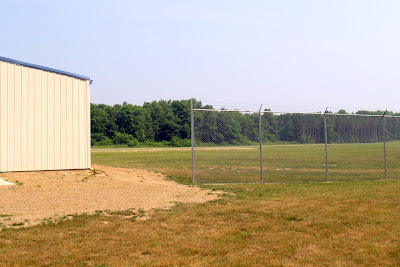
For anyone that thinks our government can stem the tide of illegal immigrants invading us from the south with a fence, consider exactly what it means for our government to build a fence. As they say, a chain (-link fence) is only as strong as it's weakest link, or in this case, gap.
Rocky Fork is the home of the only "Wildlife Diversity Area" that I've ever seen, and I naturally wondered (give my knowledge of the connotations of the word "diversity") if there is some kind of quota or affirmative action policy in place:

They also have a very nice bird observation area, although I've never had much success in seeing any birds, which may simply be a case of someone forgetting to tell, you know, the birds about it, and it's been my experience that you can't expect much by way of reading comprehension out of them:


I was a little luckier today, though, and was able to get a few pictures of this guy:


It was hot hot hot, and it looked as if there was some weather building up to the west, so I kept my walk short and headed back to Bolton after only an hour or so of walking. About 10 miles out of Bolton, the view to the left was looking pretty threatening so I ran Papa up to a healthy 2500 RPM and scooted back to the barn at a nice 155 knots. The landing was passable, what with there still being very little by way of wind to deal with. As I taxied by the FBO, I saw my AP/IA parked in front of the hangar getting his boat ready for the water. Personally, I think he made the right choice in the boat vs. airplane question today. It was a nice trip, but I wouldn't have wanted to stay out much longer than I did. As I type this, I can here thunder in the distance, signaling an impending thunder-bumper. It's good to be home when that happens! I'm not a real big fan of Weather Diversity Areas, as it turns out.
Highland Co. is typical of an Ohio county airport: a lot of slope on the runway. The automated weather system was reporting calm winds there as well, so I had my choice of runway. Coming from the north as I was, it was more expedient to enter a left downwind for runway 5, although that isn't my favorite way to land there as it is a downhill slope on the runway. That can be tricky in the flare, but with the calm air I was able to make a decent touchdown, and I got down early enough to still make the turnoff right in front of the parking area.
I parked the plane, gathered up my camera equipment, and headed for the gate to walk the half mile or so down to the lake. Parked over by the fuel pumps was this gorgeous Piper Cub:


I like the horn, and wish I could put something similar on the RV. Why, you ask? Well, some of the renters at the Bolton FBO are pretty cavalier with regards to where they park the airplanes, and it's not uncommon to have the taxiway blocked by a Skyhawk. Many's the time that I've wished for some way to encourage someone to move an airplane out of the flow of traffic.
Just outside the airport is this portal to the open-air chapel at the park:

I'm not a church-goer, but this is something I'd like to try sometime, assuming I can get down there by 8am. I guess campers don't sleep in very late!
As I walked down the road towards the park, I saw this:

For anyone that thinks our government can stem the tide of illegal immigrants invading us from the south with a fence, consider exactly what it means for our government to build a fence. As they say, a chain (-link fence) is only as strong as it's weakest link, or in this case, gap.
Rocky Fork is the home of the only "Wildlife Diversity Area" that I've ever seen, and I naturally wondered (give my knowledge of the connotations of the word "diversity") if there is some kind of quota or affirmative action policy in place:

They also have a very nice bird observation area, although I've never had much success in seeing any birds, which may simply be a case of someone forgetting to tell, you know, the birds about it, and it's been my experience that you can't expect much by way of reading comprehension out of them:


I was a little luckier today, though, and was able to get a few pictures of this guy:


It was hot hot hot, and it looked as if there was some weather building up to the west, so I kept my walk short and headed back to Bolton after only an hour or so of walking. About 10 miles out of Bolton, the view to the left was looking pretty threatening so I ran Papa up to a healthy 2500 RPM and scooted back to the barn at a nice 155 knots. The landing was passable, what with there still being very little by way of wind to deal with. As I taxied by the FBO, I saw my AP/IA parked in front of the hangar getting his boat ready for the water. Personally, I think he made the right choice in the boat vs. airplane question today. It was a nice trip, but I wouldn't have wanted to stay out much longer than I did. As I type this, I can here thunder in the distance, signaling an impending thunder-bumper. It's good to be home when that happens! I'm not a real big fan of Weather Diversity Areas, as it turns out.
Kit Ordered!!
Well, not the kind of kit that most of you immediately thought of. I ordered my kayak kit:
http://www.clcboats.com/boats/shearwater.php
It'll take a week or so to arrive, so stay tuned!
http://www.clcboats.com/boats/shearwater.php
It'll take a week or so to arrive, so stay tuned!
Friday, June 01, 2007
Root cause determined!
Yes, you're heard it many, many times here before: I sometimes have a bit of a bouncing problem with my landings. I've oft wondered how I developed that problem, having never really been a sufferer of it before. Easy to blame the airplane, it is, but not wholly satisfying for a believer in the old adage that it is a poor workman that blames his tools. Well, I have a new, equally self-serving theory, which I will share with you shortly.
We've been suffering through what I've taken to calling the "Dog Days of May" of late, with a stalled high pressure area bringing us day after day of hot, hazy weather, the type of sunny gloom normally reserved for August. Absent the August humidity, thankfully. But still, it's not the type of thing that makes my shoulders itch for the feeling of a pair of wings attached, and the freedom of tossing myself and my mount enthusiastically into the inviting sky. Last night, however, the itch returned, and no manner of hazy muck was going to dissuade, so Papa and I went for a canter around the pasture. The tower being closed as is normal after 1930 and the winds being essentially naught, we made our way to the runway being used by the solitary touch & go plane in the pattern, which for the detail-craving reader I will identify as runway 22.
With the very, very light breeze, the takeoff was stellar in its quality, and the ensuing cruise about the local area was smooth and uneventful. I was entertained by listening to the tower frequency, which after the tower closes at 1930 reverts to being the CTAF frequency. 'Tis amusing to listen in on the gaps in other's aeronautical knowledge. The first example was quick to arrive: "Cherokee [whatever] is 7 miles southwest, inbound touch & go, right traffic 22." I hear (and see, as I can watch this kind of thing from my front porch what with my home being in such close proximity to the airport) this all the time: pilots that are so in the habit of being assigned right traffic by the tower that they forget (or as I suspect, were never taught) that the pattern reverts back to the standard left traffic in the absence of the tower. In fact, this very situation came up in my BFR last week, and I'm proud to say that the CFI riding with me was slightly crestfallen that he failed to catch me in this little "gotcha." In any event, I quickly keyed the mike and mentioned to the Cherokee pilot that me might reconsider and use left traffic, what with the tower being closed and there being another airplane in the pattern that was correctly using left traffic.
Don't get me wrong: I'm not overly pedantic or a stickler for the rules. It's just that I was planning on a landing or two at the grass runway airport a scant 2.5 miles west of Bolton, and didn't relish the idea of touch & go traffic out there with me. Selfish, yes, but hey, the law was on my side.
This (finally) brings us to my epiphany on the topic of bouncy landings. This particular grass runway has the somewhat dubious honor of having been the first runway I ever landed on during my tailwheel transition, the theory apparently having been that it would be easier than a paved runway. I'm sure there's some validity in that, in general, but in the specific I now contend that I was not well served by this selection. The thing is, you see, that despite a perfect approach and touchdown, I ended up bouncing my way down the runway. Why, you ask? Well, the thing is that this runway undulates. It's wavy. It is not smooth! In fact, I contend that as a result of the various waves and dips in this runway, it is impossible not to bounce. Now, what with first impressions being lasting impressions and all, I think I have determined why I still to this day bounce my landings: the idea that an RV-6 cannot be landed without bouncing was my first impression, and I have suffered from that idea since.
Of course, this theory only works if I bounce all of my landings, and such is demonstrably not the case: I greased the later landing back at Bolton. It was a 9.5, I'm telling you. Just a brush of rubber against the runway, a slightly perceptible spinning up of the wheels, a very slight touch of forward stick to plant Papa firmly onto terra firma, a nice tail high rollout to just short of Alpha 3, and a smooth turn onto the taxiway. In front of a gob of folks gandering from JP's Ribs, too. Ah, a grand performance in front of an audience! One could get used to that!
And before we part, another interesting application of aeronautical prowess heard on CTAF:
"Cessna Caravan [something or the other ALPHA JULIET, 7 miles north, straight in runway 22."
"Skyhawk 266 left downwind 22, touch & go."
"Caravan Alpha Juliet, we'll slow down a bit and let you go in front of us."
Me (thinking, not saying): Well gee, that's awfully big of you. Maybe you ought to consider flying an actual pattern, just like the rest of us.
We've been suffering through what I've taken to calling the "Dog Days of May" of late, with a stalled high pressure area bringing us day after day of hot, hazy weather, the type of sunny gloom normally reserved for August. Absent the August humidity, thankfully. But still, it's not the type of thing that makes my shoulders itch for the feeling of a pair of wings attached, and the freedom of tossing myself and my mount enthusiastically into the inviting sky. Last night, however, the itch returned, and no manner of hazy muck was going to dissuade, so Papa and I went for a canter around the pasture. The tower being closed as is normal after 1930 and the winds being essentially naught, we made our way to the runway being used by the solitary touch & go plane in the pattern, which for the detail-craving reader I will identify as runway 22.
With the very, very light breeze, the takeoff was stellar in its quality, and the ensuing cruise about the local area was smooth and uneventful. I was entertained by listening to the tower frequency, which after the tower closes at 1930 reverts to being the CTAF frequency. 'Tis amusing to listen in on the gaps in other's aeronautical knowledge. The first example was quick to arrive: "Cherokee [whatever] is 7 miles southwest, inbound touch & go, right traffic 22." I hear (and see, as I can watch this kind of thing from my front porch what with my home being in such close proximity to the airport) this all the time: pilots that are so in the habit of being assigned right traffic by the tower that they forget (or as I suspect, were never taught) that the pattern reverts back to the standard left traffic in the absence of the tower. In fact, this very situation came up in my BFR last week, and I'm proud to say that the CFI riding with me was slightly crestfallen that he failed to catch me in this little "gotcha." In any event, I quickly keyed the mike and mentioned to the Cherokee pilot that me might reconsider and use left traffic, what with the tower being closed and there being another airplane in the pattern that was correctly using left traffic.
Don't get me wrong: I'm not overly pedantic or a stickler for the rules. It's just that I was planning on a landing or two at the grass runway airport a scant 2.5 miles west of Bolton, and didn't relish the idea of touch & go traffic out there with me. Selfish, yes, but hey, the law was on my side.
This (finally) brings us to my epiphany on the topic of bouncy landings. This particular grass runway has the somewhat dubious honor of having been the first runway I ever landed on during my tailwheel transition, the theory apparently having been that it would be easier than a paved runway. I'm sure there's some validity in that, in general, but in the specific I now contend that I was not well served by this selection. The thing is, you see, that despite a perfect approach and touchdown, I ended up bouncing my way down the runway. Why, you ask? Well, the thing is that this runway undulates. It's wavy. It is not smooth! In fact, I contend that as a result of the various waves and dips in this runway, it is impossible not to bounce. Now, what with first impressions being lasting impressions and all, I think I have determined why I still to this day bounce my landings: the idea that an RV-6 cannot be landed without bouncing was my first impression, and I have suffered from that idea since.
Of course, this theory only works if I bounce all of my landings, and such is demonstrably not the case: I greased the later landing back at Bolton. It was a 9.5, I'm telling you. Just a brush of rubber against the runway, a slightly perceptible spinning up of the wheels, a very slight touch of forward stick to plant Papa firmly onto terra firma, a nice tail high rollout to just short of Alpha 3, and a smooth turn onto the taxiway. In front of a gob of folks gandering from JP's Ribs, too. Ah, a grand performance in front of an audience! One could get used to that!
And before we part, another interesting application of aeronautical prowess heard on CTAF:
"Cessna Caravan [something or the other ALPHA JULIET, 7 miles north, straight in runway 22."
"Skyhawk 266 left downwind 22, touch & go."
"Caravan Alpha Juliet, we'll slow down a bit and let you go in front of us."
Me (thinking, not saying): Well gee, that's awfully big of you. Maybe you ought to consider flying an actual pattern, just like the rest of us.
Subscribe to:
Posts (Atom)