When you consider that my first full 10-station round with a 12 gauge was two weeks ago, and that it came right on the heels of my first time shooting a shotgun in my life, today was a resounding success. That round last week when I first tried a 12 gauge?
I shot 7 out of 50.
Today, with my new (to me) shotgun and two rounds of experience under my belt?
Missed 'em all!
No, just kidding! I can't believe how much better I did. Out of the first two pairs, I nailed three birds. It went on like that for the rest of the round. I finished with a total of 22 out of 50! Out of the five of us in the group, that was second best. The new gun worked great, but a big part of the improvement came from a suggestion from one of the guys I was shooting with. He's pretty new at it too, and he was also having the same problem I was having with trying to aim like you would with a rifle. They say with the shotgun you should shoot with both eyes open rather than with one closed as you would with a rifle. His advice was to ignore those guys and go ahead and just use one eye. It made all the difference!
I took my little camcorder with me today and while I'm a little disappointed in the jerkiness of some of the video, at least you can get an idea of what it's like.

Monday, January 31, 2011

Crossposting just to keep this blog alive
I haven't been flying at all this winter. Just the other day I was thinking about how fun it used to be to be a pilot. I've been busy on the RV-12, but even that project has its delays. As we can see here:
The down side of winter projects is....
...winter is cold!!
The reason I need winter projects so badly is that I get cabin fever something fierce. I have to have something to keep myself occupied. In fact, February is the worst month of my life because it is so hard to find something to do that doesn't involve being outside. When I started on the RV-12, my hope was that I would consistently have work that I could do down in the basement, but for the second year in a row that hasn't worked out. Last year I was forced to move to the hangar to build the tail cone. I started the fuselage in the spring and was able to spend some days in the basement that would have been nicer spent outside. This year it's the wings.
It's 6 degrees Fahrenheit outside today.
I'm inside, and I'm staying there. At least there's football on TV!
I did go out for awhile this morning, and I'll share the details of that with you since I told you about shooting Sporting Clays last weekend. I might have mentioned that I'd be wanting to get my own shotgun rather than being dependent on borrowing a gun. To that end I did some research to try to find a reasonably priced gun that offered reasonable quality in return. From what I've seen in retail stores, there is exactly one low-cost over/under shotgun, and web reviews were not favorable. That gun costs $450 new. The next one up in price (and I was assured that this was a terrific deal by the guy at the counter) was $899. Marked down from $1,200, I think. Didn't matter. You could mark down the Hope diamond from $12,000,000 to $5,000,000 - I still can't afford it.
I started looking for used guns. That's not as easy as you might think. Craig's List won't sell them, nor will eBay. I finally came across Gunlistings.com (which for some reason I keep reading as 'GunSlingers.com' - a strange mental tick, that) which is kind of a Craig's List for guns. I spent a week perusing the listings and finally found one that I was interested in. It was a Remington 310 over/under (made in Russia) for $400. It took a week for the seller to get back to me, and that was just to tell me that it was already sold.
I decided to expand my search from Columbus to all of Ohio and BAM!, I found a Verona LX-502 (Italian made) for an asking price of $525. That was a pretty good price, but somewhat over my budget. The seller accepted an offer of $460. That was only $10 over budget, and he was kind enough to meet me in Washington Court House, thus saving me a couple of hours of driving. We had a nice breakfast at McDs and chatted about guns, work, taxes, and wives. He seemed a decent and likable sort; that has been my experience with everything that I've bought or sold on Craig's List, as well as everyone I've met in shooting and gun shows.
So, here's my new sporting equipment:


I also found a few videos on YouTube that someone from the place I went last weekend has been uploading for the last couple of weeks. I suspect that it's hard to do Sporting Clays justice with a handheld camcorder, but you can kind of get the idea:
(20 gauge shells are yellow - that's why there was surprise over them being red)
Tuesday, December 14, 2010
New Stearman pix
Red Stewart Airfield is one of those quaint old airports where people will just go hang around watching (and apparently photographing) airplanes. One of my blogging buddies, Steve DiLullo who chronicles his flying activities out of his home airport at Red Stewart, came across some pictures that had been taken of my momentous flight in the Stearman. He was kind enough to pick them up and send them to me, and here they are:


Wednesday, November 17, 2010
50,000!
The PapaGolf Chronicles had its 50,000th visit today. According to the SiteMeter, the link came from Doylestown, PA and was a redirect from a Bing.com search for "old photos of power plants."
This blog is nothing if not esoteric!
This blog is nothing if not esoteric!
Saturday, November 13, 2010
My Dukakis moment
NOTE: For those arriving from the Van's Airforce web site, I need to clarify that I am not an RV-6 builder. I am an RV-12 builder, but I bought my RV-6 already flying.
Who remembers this:

Some say this picture cost Mr. Dukakis the presidency of the United States. Me? I hope that's not true or my own chance to occupy the big chair is ruined for, as luck would have it, I now have a picture of your's truly that's even worse. But we'll get to that...
Here we are in the middle of November and I was presented with a completely unexpected quandary. After all, no one expected the terrific weather we've had all week, and even less expected was that it would continue into at least one day of the weekend. But there it was in all its glory: a forecast for clear-ish skies and reasonable temperatures. I would simply have to fly somewhere. I checked the schedules of the usual suspects that accompany me, but it looked like I'd either have to go somewhere alone or see if I could still fit my ever-expanding puppy pal Cabot into the plane.
Nagging at the back of my brain has been the idea that I'd really like to get out to Red Stewart airport and get a ride in their Stearman. Having failed to find an open spot on the schedule last time I tried, I didn't think it was very likely that I'd be any more successful when calling on a Friday afternoon with the very public promise of good weather on Saturday to entice others into the same idea. I called anyway. The woman that answered the phone sounded as if she didn't expect to find any openings as she asked me to wait while she consulted the schedule, and actually sounded apologetic when she told me that the only opening was at 3:30 PM. I leapt at it! I figured that would probably be the warmest part of the day and that seemed to me to be a quite desirable detail when booking a ride in an open cockpit biplane. In November.
Still, that left most of Saturday for me to pace about in barely contained excitement. I finally gave up and headed for the airport a little after 1:00. Red Stewart is only 50 miles away and I knew I'd be horribly early, but I just needed to go. I took one last look at the forecast and spent a few moments pondering the warning of 14G20 winds before deciding that those winds, while close up against my personal maximum, were still within the bounds of flyable. The were pretty much out of the southwest, too, so I'd only be dealing with a fractional crosswind component of them anyway.
The winds hadn't yet picked up as I climbed out of Bolton Field and headed towards the southwest, but it wasn't long until we started bumping through a light but frenetic chop. It was the kind of sky that just won't allow the plane to settle into any kind of relaxed, hands-free flying. I had to keep a tight hand on the reins for the entire trip. Dialing in the frequencies of some of the automated weather reporting systems in the vicinity of my destination proved what I already knew: the promise of 14G20 winds had been kept. Well, at least I knew that it was going to be an interesting arrival!
I had no idea how interesting! Red Stewart has a grass runway and those are notoriously difficult to pick out of the surrounding farm fields, but that's what GPS is for. With only three miles remaining before the GPS would start counting how many miles the field was behind me rather than in front of me, I caught sight of it. It was the field with a high-powered plane doing aerobatics just to the north of it. Or, in other words, right where I was headed. The radio was mostly quiet with the exception of a couple of planes entering the pattern at Waynesville, wherever that was. Oddly enough, though, there were also a couple of planes entering the pattern at Red Stewart. An idea started to tug at what little attention I had remaining as I concentrated on not being speared by an aerobatic plane descending straight down out of a hammerhead stall. Oh, and there was also what looked like a Piper Cub rolling down the runway on takeoff.
Not counting the aerobatic guy, there were four airplanes in the general vicinity of the runway. One was not talking on the radio at all; he was on final and thus not much of a factor. One was on left base, but he, as with the third guy who was busy making a right 360 degree turn out of the downwind leg to increase his spacing behind the guy on base, was reporting his activity as being at Waynesville.
BING! The light came on.
Oh! I get it now! "Waynesville" is the name of the airport, not "Red Stewart!" Or they're synonymous. Whatever. It was time to cast aside all of the nagging details and get busy with landing my plane. I slowed down and dropped flaps to keep myself behind the guy that had finished his 360 degree turn and was back to flying a normal pattern. I extended my downwind to give him a little more room. I could feel the crosswind from the left as I came down final and compensated for it by keeping my left wing low. I made a fairly decent touchdown but fell victim to the oldest grass runway trick in the book: if you don't make a full stall landing, the humps and bumps in the runway will bounce you right back into the air. There's only one result to that: an embarrassingly bumpy arrival. Which, after having very publicly embarrassed oneself, leaves only a single path of recourse: park far away from the spectators.

Unfortunately, I parked with the gusty wind at my back. The wind was strong enough that it was slapping the rudder from stop to stop, a situation that I simply cannot tolerate. It's horribly hard on the hinges and can even result in small dents in the skin of the rudder if it bangs hard enough to contact one of the screw heads protruding through the fiberglass fairings. I had to dig around in my just-in-case kit to find the rudder lock that I use to immobilize the rudder in situations like this. I don't like to use it because I'm afraid I'll forget to remove it before trying to taxi out to the runway. I'd know if I had forgotten it pretty quickly since I wouldn't be able to turn the airplane, but it would be terribly embarrassing to have to shut down and go back out to remove it. Worse, even, than forgetting to remove a chock. And, well, my local reputation as a competent pilot wasn't all that great anyway, what with the preceding landing and all.
With an hour and a half to kill, I entertained myself by walking around soaking up the ambiance of the rustic airport. I even managed to talk to a few folks with none of them making any mention at all of my landing. Maybe it wasn't all that bad after all. Or maybe they were just being polite. Either is fine with me.


At about 3:15 I was approached by a guy that asked if I was Dave. "Well, yes I am!" I replied. "I'm Dave too. Are you here for the Stearman ride?" Ah, early! What a stroke of luck! I was more than a little afraid that they might be running late and that I'd run into a shortage of daylight at the other end of this little adventure. We walked over to a pair of hangars, between which the Stearman was hiding.

Dave went through the preparations for starting the big radial engine. It was apparent that pilot/cadets of the late 30's were horribly spoiled because the airplane had obviously been designed for an external crewman to start. Note from Dave's efforts that the engine is primed from outside the cockpit. And if that's not evidence enough, note that right next to the primer knob is a slotted orifice that a crank handle inserts into. After priming the engine, the poor crewman would be forced to turn that crank in order to spin up a massive flywheel under the cowl. When the pilot/cadet hollered out that the magnetos were live, the crewman would pull a knob that would transfer the rotational energy of the flywheel to crank the engine over. If he was lucky, the engine would start on the first or second try.

Dave didn't make me do that, although he did relate the story of an aspiring Stearman pilot that had wanted to try it himself, ostensibly for the "authenticity" that's in it.
He only asked once.
With those preparations out of the way, I was invited to alight. And given my status as a pilot (Dave had been up flying when I arrived, and who was I to disabuse him of the notion that I had done it well?) he insisted that I sit in the back seat. Oddly enough, that's considered to be the pilot's seat. It probably has something to do with weight and balance when flying solo. In any event, I jumped at the chance. He gave me a quick description of the contortions I'd have to go through to climb all the way up there and into the seat before heading on up to the front seat himself. Luckily he was still facing to the front as I clumsily crawled over the side coaming and ignominiously plopped down into the seat.
As I was in the official pilot's seat, I'd have some duties not normally entrusted to uncredentialed goundlings. First, once he was belted in and ready to start the engine I'd have to flip the battery switch to "on." Once the engine had started, I'd have to flip the radio switch to "on." That particular operation seemed kind of gratuitous because I could quite plainly see the void where the radio used to be installed, but I suppose it had something to do with the intercom.
All that was left to do was to fasten and snug down the safety belts which, considering the complete lack of any overhead structure to keep me in the airplane, was a task that I paid particularly rapt attention to. Oh, and I had to put on the cloth helmet/headset thingy. And it was at that precise moment that any thoughts and dreams about attaining high political office were dashed forever.

As surely as Napoleon had his Waterloo, I had finally had my long-dreaded Dukakis moment.
And you know what? Within just a couple of minutes I wouldn't care! Not in the least!
Radial engines don't seem to roar into life all at once like the little four cylinder bangers that I'm accustomed to. Rather, they bang and splutter and spit out flames and noxious clouds of smoke as they seemingly reluctantly come to life. Frankly, that is a great deal of their appeal. As I've often said, the primary function of airplanes like the Stearman is to convert large quantities of expensive petroleum products into noise. Sweet, wonderful noise, of course, but noise nonetheless. And I'm here to tell you, it sounds just as nice from inside the airplane as it does from the outside.
I sat there for a couple if seconds in awe of the momentous moment. This was, after all, the very first time I had ever even sat in a venerable classic like a Stearman, and now here I was getting ready to fly in one! Surprisingly, I even remembered to turn on the second switch!
What? Did I hear him right? It seemed that Dave had just said that he would taxi us out from between the hangars and then I could take over. Really?? That was not what I had expected at all! And I was completely unprepared for it; I had cameras spread out all over the place back in my little cubbyhole, ready to record every moment of the ride. I started trying to find places to put all of the cameras where I'd still be able to get at them later. That proved challenging since in my zeal to not fall out of the airplane I had snugged myself down very, very tightly. I couldn't get to any of my pockets!
I managed to get everything tucked away through the simple expedient of sitting on whatever I could get under my thighs and tucking one of the thinner cameras underneath one of the shoulder straps. As I took over the steering of the plane (and asking Dave to make sure that if I was going to hit anything to please make sure it was anything other than the little gray airplane over there by the runway) I quickly realized one very critical difference between sitting in the back seat of a Stearman versus sitting in an RV-6: you can't see a blooming thing from the back seat of a Stearman. It steers pretty well, although I don't think the tailwheel does anything other than freely swivel around. It seemed that I could make gentle turns by using full rudder throw (and man, do those pedal travel a long way!) and could encourage tighter turns by stabbing at the brakes. It was actually pretty easy to taxi once I got in the habit of making frequent S-turns in order to see what was out in front of us.
I managed to get us to the end of the runway without running over anything, although I did exhibit a tendency to taxi faster than Dave was comfortable with. The problem is that my airplane is very small and light compared to a behemoth like the Stearman and I'm therefore used to being able to stop quickly. The Stearman, on the other hand, weighs 3,000 pounds. It doesn't do anything quickly. There are a lot of people and little bitty airplanes moving around at Red Stewart, so a walking pace while taxiing is the way to go.
When we reached the end of the runway, Dave had me point the plane into the wind and do the engine run-up. That was performed in a similar manner to the way I do it in the RV-6 with one notable exception: the tach rotates counter-clockwise, as opposed to just about every other tach in the world. With the run-up done, Dave had me position the plane on the runway. He then told me we'd do the takeoff together - he'd man the rudders while I did the rest. He asked me to be gentle with the throttle until reaching 1,500 rpm since there is a notable burble right around 1,300. "Notable" is a generous description. "Startlingly abrupt" seems more apt in the event.
I actually did pretty well with the takeoff, although I was surprised at how long it took to get up to flying speed. This is, by the way, another area in which grass runways try to trip you up. The same humps and bumps that kept me from landing smoothly also try to throw the plane into the air before its truly ready to fly. After a few false takeoffs with resultant bouncy returns to the runway, I got us into the air and climbing out at a sedate 60 mph.
Did I say "sedate?" Well, when viewed from a distance I'm sure it looked that way. When sitting in an open cockpit biplane, though, no speed over 10 mph can be described as anything other than "unremittingly loud." The first thing I remember is the wind getting under the lip of the cloth helmet/headset thingy and making it feel like a hat that's getting ready to blow right off of your head. It took a couple of frantic grabs at it before I fully internalized that it wasn't going anywhere. As we accelerated to a blistering 75 mph for our excruciatingly slow climb to 1,500' AGL, I started to notice that the buffeting from the air was getting more than a little abusive. It only took a couple of minutes to realize that my eyebrows were going to hurt for the rest of the day from my eyelids flapping up and slapping them. I'm not complaining here, mind you, but I have to say it: a pair of goggles would have been nice!
I was desperate to take some pictures but I couldn't bring myself to relinquish the controls. Years of practice in the RV-6 came to my rescue, though. If there's one thing I can do, it's fly with one hand and take pictures with the other.


We eventually reached our desired altitude and I put the camera away. I don't know how long it took to get to altitude since there's no vertical speed gauge in the panel. I suspect they had it removed because they considered it to do nothing but taunt them as they struggled for altitude. And really, who needs an instrument to tell you that your exact rate of climb is "lethargic." Actually, I'm not sure why they even have an airspeed indicator either. With the wind buffeting my eyelids, I cast a glance down to the panel to see how fast we were going, fully expecting to see 120 or 130 mph. Nope.
80 mph.
It seems like no matter what I did with the throttle, no matter what position I put the airplane in, every time I looked at the airspeed indicator we were doing 80 mph. It is truly the one-airspeed airplane! Climb at 80, cruise at 80, land at 80. I have yet to figure out why it has a throttle at all - it seems like an on/off switch would suffice.
Anyway, once at altitude Dave told me I could play around with the plane if I'd like to. He only had to offer once! I started with some shallow banked turns to get a feel for it, eventually working my way up to wingovers and steep turns. I found the plane to be responsive in the things you need it to do such as normal, routine flying, but very heavy if you asked it to hurry things along. In other words, it would willingly roll into a turn with very little stick force, but you could heave as hard as you wanted to move the stick further over and still have very little effect on the rate of the roll. The rudder was the same way - it was much lighter than I had expected it to be, right up until I asked it to force the nose down while we were in a steep bank at the top of a wingover.
I also discovered that the Stearman will not pick up speed willingly, but it will gladly shed it like a Husky dropping coat in August. When I toss the RV-6 around I have to be very careful to keep it from picking up great gobs of speed; with the Stearman I had no such worries, but I had to make sure I didn't lose too much. I also noticed that I started to learn a few moves that I could use to avoid the worst of the air blast. For example, I soon learned that you can duck your head into the inside of a steep turn to avoid the blast of hard air you get if you haven't coordinated the rudder and ailerons correctly. Still, even with the ability to score a few brief calm moments I wouldn't want to fly a long cross-country in one of these things.
Right around the time I had had enough of flinging the plane around (to the degree that a plane that heavy can be flung, anyway), Dave asked me to climb higher. It was his turn to fly! We had briefly discussed my appetite for advanced maneuvers like loops before takeoff and I had blithely answered in the affirmative. Yes, please, let's have some! What I hadn't fully considered was the difference between me doing loops and me riding with someone else doing loops, particularly in an airplane with no top! It was too late to back out, though, what with the enormous investment that had been required to put another thousand feet between us and the cold, hard earth. I pinched the seat cushion just a little tighter and gave him the go-ahead.
In the RV-6, I can pull a loop from straight and level cruise. And I can make them big and lazy, too, since the engine doesn't have to fight a bunch of drag to get us up to the top of the loop. Not so with the Stearman. It took a long (well, it seemed long. It was probably no more than five seconds) steep dive followed by an abrupt pull-up to get us through to the other side. It was fun, though. Dave followed that up by slowing us into a stall and kicking the rudder over to drop us into a spin. We made a two or three turn spin and pulled out when we got back down to our original 1,500' altitude.
Our half hour was just about up so he asked me if I'd like to try landing. I shared that I thought that was asking a bit much since I had completely lost track of the airport in the spin and simply couldn't see it anywhere. That should have been a clue - there's only one blind spot in a Stearman: straight ahead. It's the definitive "he never knew what hit him" airplane; you could hide a mountain out in front of one of these planes. With that navigational problem solved, I agreed to give it a try.
We entered the pattern directly over the center of the runway and heading for a left downwind. I timed the turn to downwind well enough, but every time I tried to start bringing the plane down lower, Dave stopped me. We ended up on what I thought was short final at 600' AGL. I say that I "thought" we were on short final because the entire airport was blocked by the front of the airplane. That's when I found out why Dave had wanted to keep all of the altitude in the bank; he rolled us into a left-wing-low forward slip and voilà, there was the airport.
I'd like to be able to say I made the landing, but I have to confess that after the first bounce I was just along for the ride. Once Dave had gotten us settled onto the runway, I took over and got us slowed down to taxi speed. I taxied us back to park right by Papa. Shutting down the engine was the same as in most piston engine planes: mixture to cut-off and magnetos off. The only difference was the abject relief that the noise and wind had stopped.


And that was it. All done.
I'm going to do it again next year, I think.
We had done pretty good on time and I didn't have to worry about getting back before dark after all. Still, it was nice to sit in relative quiet and calm of my own plane while cooking along at a more reasonable speed, even if I did suddenly have a disconcerting tendency to over-control it.

Sunday, October 31, 2010
It's a Blustery Year
Yep, it's that time of year again. Late fall is when the bluster is at its worst, although there are some years that are certainly worse than others. 2008 was horrible and 2012 will likely be far worse, but the campaign season of 2008 has been plenty bad enough. Oh, you thought I meant blustery weather? Well, we've had that too. I had hoped to give a ride to a co-worker last week but the 23G30 winds were clearly too much; we had to postpone. That's the kind of wind that I only land in if I'm returning from a trip and I'm met with conditions far worse than forecast. I can do it if I have to, but if I have a choice? Nope, I stay home.
Today was better, but not entirely perfect. We had a reported steady 9 knots from the northwest, but one look at the sky was enough to tell that there was probably more than that going on at altitude. It was clearly blowing pretty hard up in the flight levels where the jets ply their trade; you can always tell it's windy when the clouds look like they've been applied to the sky with a brush. There's nothing wrong with a local hop with 9 knot winds, though. No reason to postpone this time, but I did suggest dressing warmly. It can be pretty chilly between the hangars when the wind forces its way between them and I knew we'd have to spend some time talking before getting into the plane.
The passenger, a future winner of the Caldecott Medal for her as-yet-unwritten children's book Everyone Knows a Dog Named Molly, asked if she could bring her family along with her in order to take some pictures of her daughter in the airplane. I could hardly refuse, what with some of my absolutely favorite pictures of Co-pilot Egg being those taken in one airplane or another. Egg, herself always eager to befriend younger kids, volunteered to brave the chill and go to the airport with us to help with the logistics of the photo taking.

She was quite happy in the plane until Egg tried putting headsets on her. That wasn't very popular at all!

To be fair, those ear cups are mighty cold when there's a chill in the air. I don't much like putting them on either!
While Egg was entertaining her guest, I did the preflight and explained a few of the things that I've learned to point out to passengers. Chief amongst those are things like:
1) The engine vibrates a lot more than what you're used to in a car and is quite loud. It also sometimes burbles when I throttle back to land.
2) I'm going to be pretty active on the rudder pedals during takeoff and landing. It's best if they're not being used as foot rests. This is especially important when it's windy.
3) And most importantly when flying with females: I will be reaching for the trim knob now and then, and any contact with your leg is purely incidental. In fact, I was thinking that one nice thing about the RV-12 will be that the trim is electric and actuated by a switch on the control panel, thus alleviating me of the concern that something might be misconstrued. My relief was short-lived, however, as I soon remembered that I'm going to have to brief the use of the crotch strap in the RV-12, something I don't have to do in the -6. That's going to require a level of delicacy that, simply put, I'm not exactly known for.
Not that it was an issue with Molly, but one of the benefits of explaining these kinds of things as we go through the process is to alleviate some of the nervousness someone might have when flying in a small plane for the first time. Confidence and competence, even if feigned, go along way towards calming jangled nerves. I remember one of my earliest flights in a small plane when I grew increasingly trepid as the pilot struggled to get the engine started. That's no problem with Papa, of course, since he always starts after pulling just one or two blades through. Such was the case today, although I just couldn't seem to keep the engine running after its normally easy start. I think it was the third or fourth time I had tried before I realized that I still had the mixture in idle cut-off. Oops! But, as I've always said, there are two people you never want to hear say "Oops!": pilots and brain surgeons. I put on my best meant-to-do-that voice and said, "Ah, I had it set a little lean."
Technically true, that, albeit in a somewhat Clintonian sense. It all depends on what the meaning of "a little lean" is.
Being early yet, we woke up the tower controller with our request to taxi but eventually managed to wrangle a clearance to runway 4 out of him. On the way out I explained that we'd have a left crosswind on takeoff which, combined with the normal right turning tendency from the torque of the engine, would ensure that there would be at least a few swerves as we accelerated down the runway. I also briefed my normal runway 4 takeoff method of accelerating to 120 knots over the runway before making a climbing turn-out towards the wide open farm fields just west of the airport. Doing it that way results in us being at 500' above the ground with best glide speed already showing on the airspeed indicator should anything happen that would require an un-powered, off-airport landing, but it's not the type of takeoff one would expect after hundreds of hours flying in airliners.
All went as planned and we were soon climbing towards the west. I had debated on the question of making my normal takeoff or foregoing that and climbing out straight ahead, the two choices pretty much differing mostly by how they would affect the passenger, but in the event my final decision to go with the more abrupt and potentially scary method was proven satisfactory by the gleeful laughing bubbling out from the right seat. That was a relief! If she enjoyed the takeoff, chances were that I wouldn't have to be ultra careful about banks and turns.
Once we got up to a safe altitude, I let her take the controls. My early impression proved correct. After just a few mild exploratory turns, she loosened up and rolled us into 30- to 40 degree banks quite readily. We were lucky to have a few scattered target clouds to play around with too. It's somewhat rare to have those bite-sized clouds lounging around at a convenient altitude, and when I do find them I like to play around with them a bit. As there was one just below and to the left of us and Molly was obviously getting more comfortable with controlling the plane, I had her put us in a descending left turn straight towards it. We brushed across the top of it at a good 175 mph. That's a great way for someone new to flying to see just how fast it is that we're going. It's hard to tell when you're a few thousand feet above the ground, but the close-up reference to a stationary cloud shows it very well.
She then flew us over another little cloud just behind the first and I took over as we zoomed on past it. I pulled us up into a left wing-over and dove back down towards the cloud we had just brushed over. After three or four of those, we had both had enough fun to last us the day. Which is to say, well, there was a little queasiness afoot. Pulling G's like that is an acquired taste and something you have to do pretty routinely to stay acclimated to it. She'd never done it, and I hadn't done it for a long time. It was time to move on to something more sedate.
I headed us back towards the east, the plan being to fly over The Ohio $tate University campus and downtown Columbus. Unfortunately we were over a pretty thick haze layer. While the sky was beautiful at 5,500', the view of campus and the downtown waterfront wasn't that great. I turned us back to the west and we descended back down towards Bolton. I called the tower as we crossed over Darby Dan and got the expected "report mid-field left downwind runway 4" in response.
As we crossed over my neighborhood, I made a continuous curving approach from downwind to final. We still had quite a bit of altitude, but with the throttle to idle and a good headwind component we had no problem losing the excess height by the time we reached the runway. I had covered my bases in preparation for a bad landing during the briefing, but it proved unnecessary. The touch down was smooth, and had it not been for a gust of wind that caused a little swerving and bouncing on the roll-out, it would have been a very good landing for a blustery 9 knot day.
Sunday, October 24, 2010
There's no such thing as a routine flight
I'm not the first to say that there is no such thing as a routine flight, nor is it an idea that I've but recently pondered. It's just that it was proven to me again yesterday as I made a trip that I have made more often than any other, if I exclude shorter hops like MadCo and Urbana. I'll modify the criteria by defining "trip" as a flight upon which I spend more than an hour on the ground and actually leave the airport itself. I make plenty of those, but none as often as I make the trip to The Farm. If anything in my aerial repertoire could be counted as a routine flight, that would be it.
The last couple of times I've gone, though, I've dealt with events that are slightly out of the norm. The last time I went, I ended up using the Garmin 396 and its XM-based weather radar display feature to circumnavigate an inconveniently placed storm cloud. This trip too involved dealing with a little bit of weather, but it was much more widespread. We had 11,000' ceilings for most of the day, which were easy enough to stay underneath with adequate visibility, but they unfortunately also produced some light to moderate precipitation. There was nothing all that difficult about it, but it is a stark departure from the days when even a hint of green on the radar was enough to me to just decide to stay home.
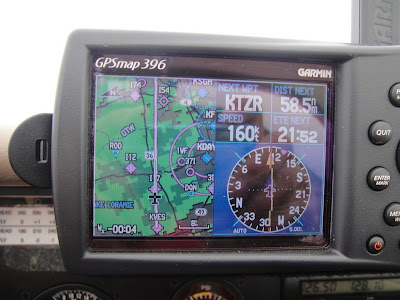
This is what it looked like on the way home. Note the ground speed displayed on the GPS - that's with the engine throttled back to an economical 2,200 rpm. The trip from Bolton to The Farm was also at a 2,200 rpm setting, but resulted in only 115 knots across the ground. So yeah, it was a bit windy at altitude.


The more interesting event was on the trip out when I saved a minimum of two lives, one (and if I'm honest, the more important) being my own. As I was flying along at 3,500', my normal scan outside the cockpit detected another airplane that was headed on an almost parallel heading, but about 500' higher than me. I say almost parallel because he was slowly converging on me. I watched as he crossed almost directly over me from right to left. Given his obvious fixation on his course, no demonstrable effort to avoid me, and the fact that he was 500' above me, I assumed that he was on an IFR flight plan. This notion was reinforced by the fact that we were just northeast of Dayton International's Class C airspace and he was headed right at it.

I decided to keep an eye on him. As we continued to the west, I could see him a mile or two off to the south. I kept expecting him to start a descent into Dayton, but his altitude remained constant. He made a couple of steeply banked course corrections, something that would be abnormal in true IFR conditions, but we were still in good visual conditions so there would really be nothing precluding him from an aggressive correction. I kept glancing over every couple of minutes or so until about five minutes later when it appeared that he might be getting closer to me again. I increased the rate of my glances to every 30 seconds; it soon became abundantly apparent that he was, in fact, closing the gap between us. Eventually he got close enough that I had to take evasive action. I descended a few hundred feet to allow him to cross directly over me. He never knew I was there! Had I not kept watching for him, there is a very real chance that he would have flown right into me. How close was he? I could have easily read a one-inch high tail number if it had been painted on the bottom of the fuselage.
This is why we look out the window!!
While I was at The Farm, I stopped by my brother's place to see what he's working on. This time around, it was his new race car for next season. The Schmetterling sponsored ride has been stripped of its goodies and relegated to jack stands. Reportedly, the Schmetterling logo will be even larger on next year's car!

The last couple of times I've gone, though, I've dealt with events that are slightly out of the norm. The last time I went, I ended up using the Garmin 396 and its XM-based weather radar display feature to circumnavigate an inconveniently placed storm cloud. This trip too involved dealing with a little bit of weather, but it was much more widespread. We had 11,000' ceilings for most of the day, which were easy enough to stay underneath with adequate visibility, but they unfortunately also produced some light to moderate precipitation. There was nothing all that difficult about it, but it is a stark departure from the days when even a hint of green on the radar was enough to me to just decide to stay home.
This is what it looked like on the way home. Note the ground speed displayed on the GPS - that's with the engine throttled back to an economical 2,200 rpm. The trip from Bolton to The Farm was also at a 2,200 rpm setting, but resulted in only 115 knots across the ground. So yeah, it was a bit windy at altitude.


The more interesting event was on the trip out when I saved a minimum of two lives, one (and if I'm honest, the more important) being my own. As I was flying along at 3,500', my normal scan outside the cockpit detected another airplane that was headed on an almost parallel heading, but about 500' higher than me. I say almost parallel because he was slowly converging on me. I watched as he crossed almost directly over me from right to left. Given his obvious fixation on his course, no demonstrable effort to avoid me, and the fact that he was 500' above me, I assumed that he was on an IFR flight plan. This notion was reinforced by the fact that we were just northeast of Dayton International's Class C airspace and he was headed right at it.

I decided to keep an eye on him. As we continued to the west, I could see him a mile or two off to the south. I kept expecting him to start a descent into Dayton, but his altitude remained constant. He made a couple of steeply banked course corrections, something that would be abnormal in true IFR conditions, but we were still in good visual conditions so there would really be nothing precluding him from an aggressive correction. I kept glancing over every couple of minutes or so until about five minutes later when it appeared that he might be getting closer to me again. I increased the rate of my glances to every 30 seconds; it soon became abundantly apparent that he was, in fact, closing the gap between us. Eventually he got close enough that I had to take evasive action. I descended a few hundred feet to allow him to cross directly over me. He never knew I was there! Had I not kept watching for him, there is a very real chance that he would have flown right into me. How close was he? I could have easily read a one-inch high tail number if it had been painted on the bottom of the fuselage.
This is why we look out the window!!
While I was at The Farm, I stopped by my brother's place to see what he's working on. This time around, it was his new race car for next season. The Schmetterling sponsored ride has been stripped of its goodies and relegated to jack stands. Reportedly, the Schmetterling logo will be even larger on next year's car!

Subscribe to:
Posts (Atom)